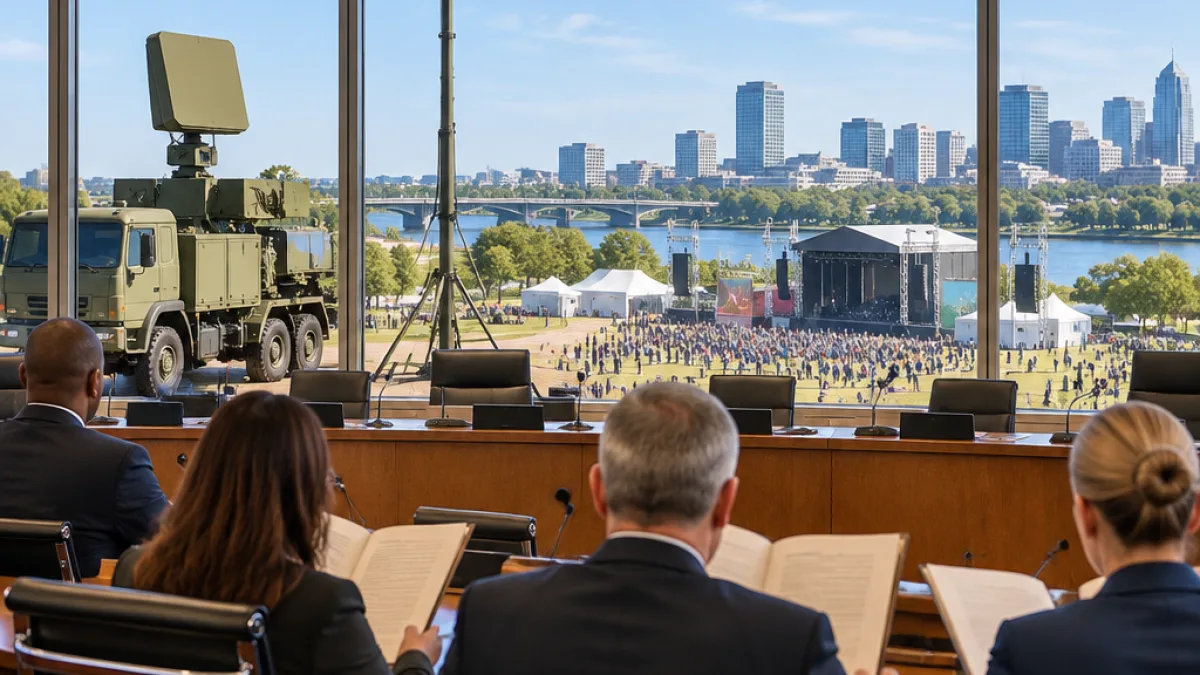
Houston City Council is scheduled to vote Wednesday on whether the Mayor’s Office of Public Safety and Homeland Security may apply for funding from the second $250 million round of FEMA’s Counter-Unmanned Aircraft Systems Grant Program. The proposed application would seek equipment and support for drone detection and mitigation at special events in the Houston region with a federal SEAR rating.
The council agenda describes the objective as improving law-enforcement capabilities at those events, but it does not identify how much Houston could receive. Texas has roughly one-third as much money available in this round as it had for the World Cup, according to the reporting reviewed by KPRC 2 and DroneXL. The vote would authorize an application; it would not itself award federal money to Houston.
“more eyes in the sky”
KPRC 2 used that phrase when previewing the proposal’s purpose on Monday. Larry Satterwhite, who directs the mayor’s public safety office, told the station that the funding would help the city improve its ability to observe activity over a wider area. City officials are also working on controls for how the technology would be deployed, with much of the operational capability expected to go to the Houston Police Department.
What the FEMA program can fund
FEMA’s fact sheet for the grant round covers both systems that identify unmanned aircraft and equipment intended to disrupt or take control of them. The listed categories include:
- Radar and radio-frequency direction-finding systems
- Electro-optical and infrared cameras, acoustic sensors and Remote ID receivers
- Mobile jammers, radio-protocol manipulation and cyber takeover systems
- Vehicles and trailers used to transport the equipment
Detection is a central part of the proposed capability. Remote ID receivers can use a drone’s broadcast to help locate the aircraft and the person operating it, while other sensors provide additional ways to monitor the airspace. The agenda language focuses on events with a federal SEAR designation rather than creating a general authorization for counter-drone operations across Houston.
Federal limits on mitigation tools
The Safer Skies Act governs which agencies may use mitigation equipment funded through the program. The eligible users described in the reporting are accredited law-enforcement or correctional agencies, and operation must be performed by officers certified through the FBI’s National Counter-UAS Training Center. That distinction is significant because detection equipment and mitigation equipment are not treated as interchangeable capabilities under the grant framework.
Agencies that purchase detection equipment with the grant must also provide the Department of Homeland Security with relevant detection information. The required data can include flight tracks and Remote ID information. The condition ties any local deployment supported by the grant to federal access to information collected during counter-drone monitoring.
Houston has pursued earlier funding
Wednesday’s decision follows an earlier Houston action. City Council approved an application for the 2026 round on February 18. In May, the council agreed to reimburse the Harris County Sheriff’s Office up to an amount that was not fully stated in the reported material. The earlier action indicates that Houston’s counter-drone planning has involved cooperation with the county sheriff as well as city departments.
The immediate question before the council is therefore procedural but consequential: whether the mayor’s public-safety office can submit Houston’s request for the current FEMA round. The final size of any award, the equipment Houston would obtain and the agencies that would receive operational responsibility would depend on the federal grant process and on the local controls officials are developing.