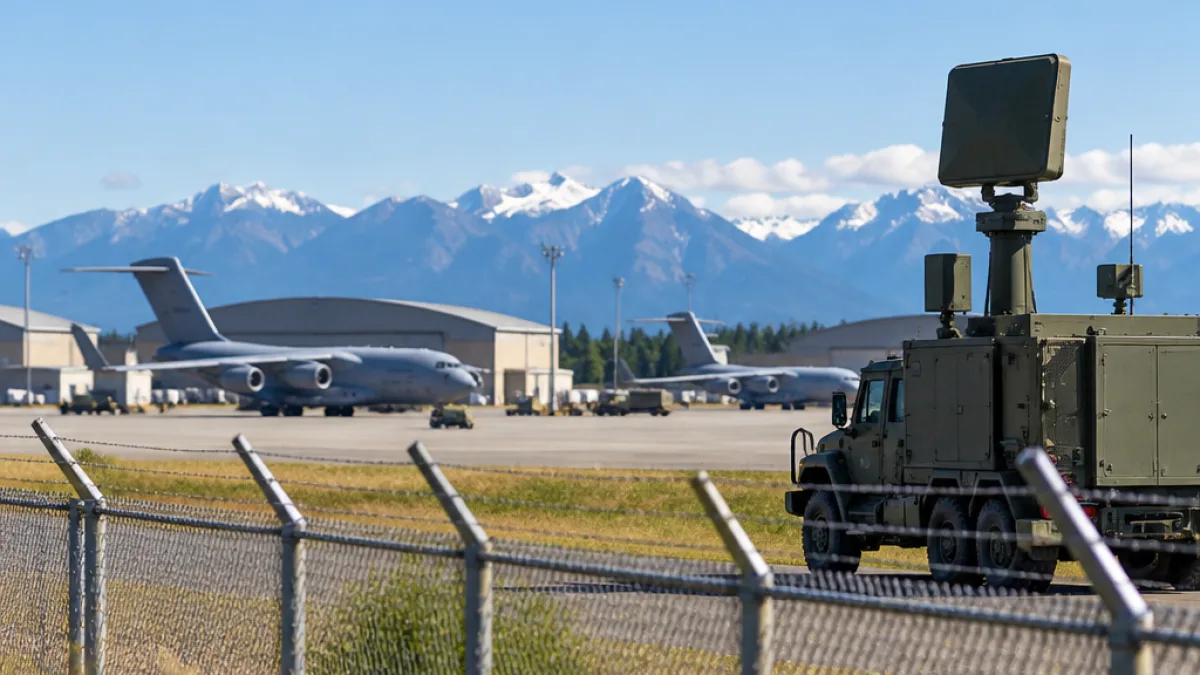
A newly disclosed Canadian military report describes a counter-drone system failing to detect an unauthorized aircraft over CFB Trenton in September 2025. The operator was not identified, and the incident was not followed by an interception, according to records obtained by CTVNews.ca through an access to information request.
The incident is part of seven reported drone cases during 2024 and 2025 at CFB Trenton in Ontario and CFB Cold Lake in Alberta. The reports indicate that none of the aircraft were intercepted and that investigators did not identify any of the operators.
Two major air bases involved
CFB Trenton is one of Canada’s principal military aviation facilities and houses transport aircraft including the CC-177 Globemaster III. CFB Cold Lake hosts a significant portion of Canada’s CF-18 fighter jet fleet. The locations therefore combine operational aircraft, supporting infrastructure and personnel with the security demands of active military bases.
CTVNews.ca reported that the counter-drone system deployed at Trenton did not detect the aircraft involved in the September 2025 event. The records do not establish who operated the drone, why it was flown over the base or whether it collected information. They do, however, show a repeated inability to identify operators or take action against the aircraft in the cases reviewed.
“There’s no doubt that our adversaries have capabilities to cause us significant harm and we do not have the capabilities to deal with that,” said retired Royal Canadian Air Force lieutenant-general Christopher Coates, speaking to CTVNews.ca.
Coates previously served as the deputy commander and highest-ranking Canadian at Norad, the joint Canada-U.S. continental defense organization. He is now director of foreign policy, national defense and national security at the Macdonald-Laurier Institute, a public policy think tank.
Defense concerns extend beyond the flight line
Coates said the risk is not limited to a direct attack on aircraft or base facilities. He pointed to infrastructure that supports military operations and is more difficult to protect as a potential vulnerability.
“To really affect Canada and our military, you don’t need to attack a base or the aircraft or the ships, you can attack dependent infrastructure,” Coates told CTVNews.ca. “So electrical distribution and transmission networks, the transportation system, resupply systems – they’re all soft, none of them are protected.”
The incidents also coincide broadly with a period of increased attention to reported drone activity around military facilities in Europe. That timing does not establish a connection between the Canadian cases and those reports, and the records described by CTVNews.ca do not identify the operators or attribute the flights to a foreign government.
- Seven incidents were documented at CFB Trenton and CFB Cold Lake during 2024 and 2025.
- A counter-drone system failed to detect the aircraft involved in the September 2025 Trenton incident.
- No operators were identified and no drones were intercepted in the cases described.
The disclosures highlight the difference between recognizing a drone report and establishing an actionable airspace incursion. For military operators, detection is the first step in any response, but the records described by CTVNews.ca show that detection, attribution and interception remained unresolved across the incidents reviewed.