The U.S. Army has tested an unmanned aircraft fitted with a 3D-printed engine designed to run on heavy fuel, according to the Army. The research is aimed at addressing power and thrust constraints that can limit the performance of military drones, particularly aircraft expected to operate with heavier payloads or in difficult environments.
A hybrid power plant for vertical takeoff
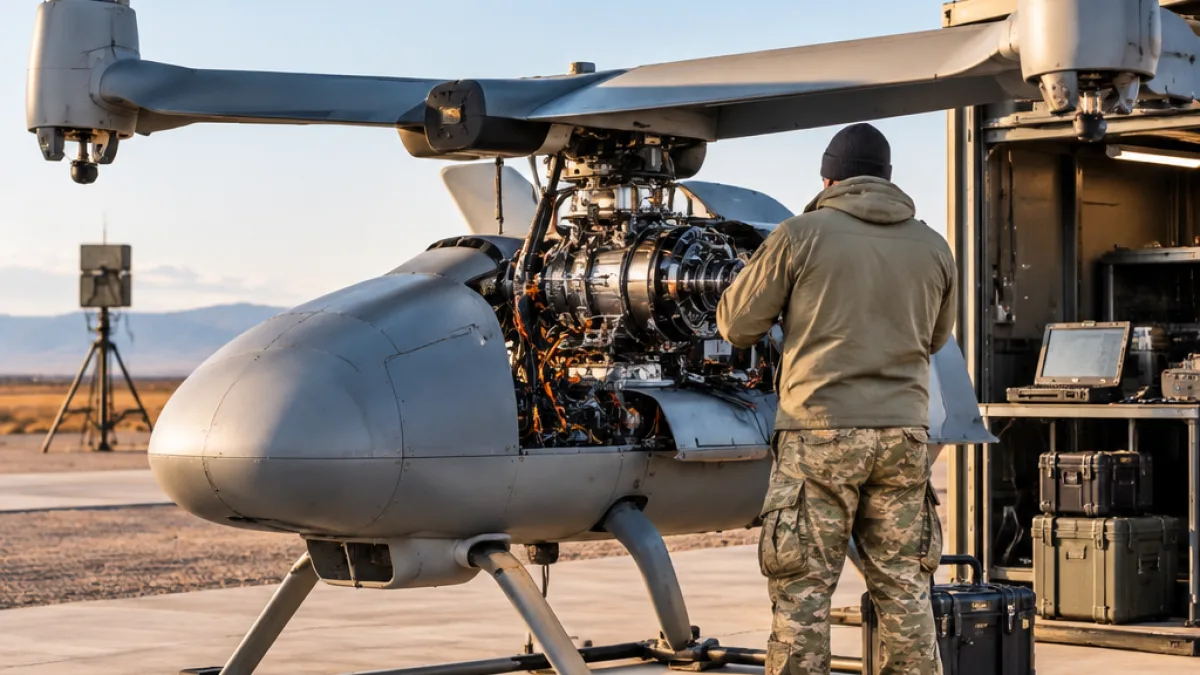
Researchers at the U.S. Army Combat Capabilities Development Command developed the engine through a research program focused on extending the operating capabilities of unmanned aircraft. The Army said the new rotary engine was integrated with a 400-volt motor-generator system. Together, those components form a heavy-fuel series-hybrid power plant.
The system was developed to support vertical takeoff and landing, including operations under challenging conditions. The Army described the work in terms of intended capability rather than a completed operational deployment: the program is designed to help drones fly longer and faster, operate at higher altitudes, carry heavier payloads and function in extreme conditions.
Chol-Boom Kwon, the research program director, said the effort is addressing several power-system requirements at the same time.
“The program addresses critical issues of power and thrust, which should allow drones to fly longer and faster, operate at higher altitudes, carry heavier payloads, and operate in extreme conditions,” said Chol-Boom Kwon, research program director.
Research focused on heavy-fuel combustion
According to the Army, researchers used hydrodynamic modeling during development to address the challenge of efficiently burning heavy fuel in a rotary engine. The team reported improvements in fuel atomization and vaporization, while also minimizing leaks of compressed air and fuel vapor.
Those engineering steps are part of the Army’s effort to combine a heavy-fuel engine with electric generation in a single aircraft power system. The extracted Army account did not identify the unmanned-aircraft model, the test location, the flight duration, the speed reached or the payload carried during testing. It did, however, describe the aircraft as a new unmanned aerial vehicle intended for further experimentation.
Further trials planned with military partners
The Army plans to provide the new unmanned aerial vehicle to U.S. military partners for additional experimentation and development. That phase is intended to allow continued testing and assessment of the technology under different conditions.
- Power system: 3D-printed rotary engine paired with a 400-volt motor-generator
- Fuel: Heavy fuel
- Aircraft role: Vertical-takeoff-and-landing unmanned aircraft
- Next step: Further experimentation with U.S. military partners
The Army’s announcement places the project at the research and testing stage. It does not announce a procurement, an operational fielding decision or a production schedule. Further trials with military partners will determine how the hybrid power plant performs across the range of conditions identified by the Army.