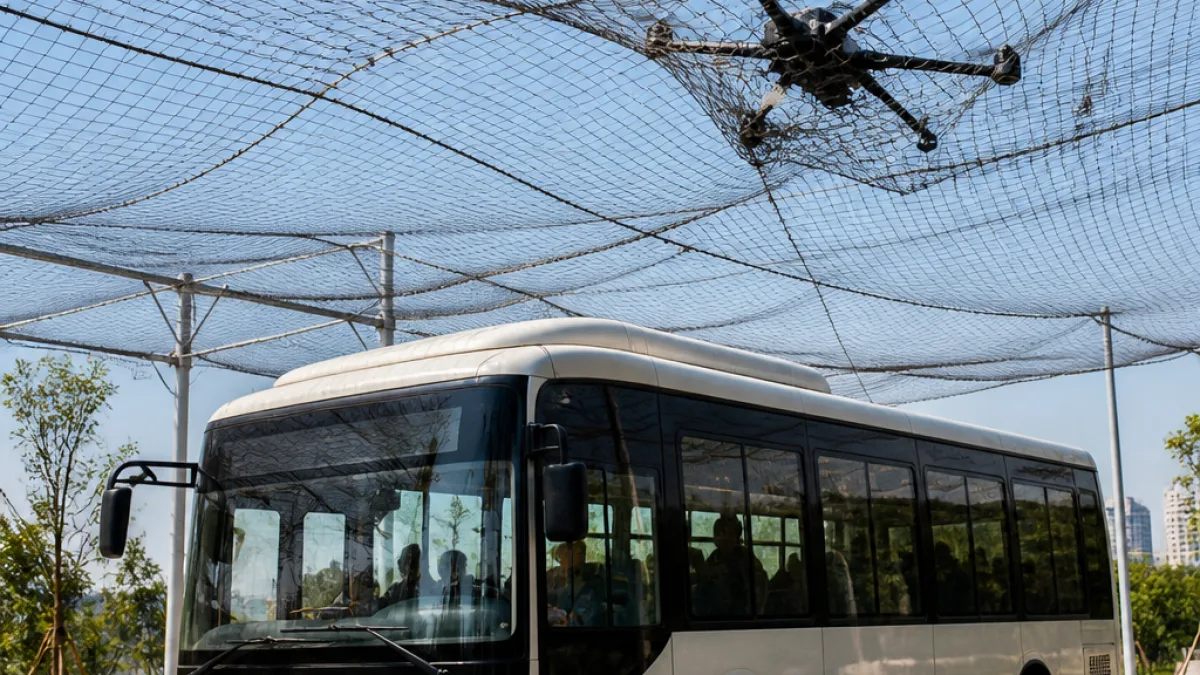
An anti-drone net stopped a Russian FPV drone from reaching a municipal bus in Zaporizhzhia on October 27, according to Mykhailo Semikin, acting head of the Zaporizhzhia Regional Military Administration. The drone became entangled in the net and exploded before it reached the vehicle, he said.
Semikin reported that the bus sustained minor damage and that all passengers were safe and unharmed. The account places protective netting at the center of an attempted attack on civilian ground transport, rather than describing a drone interception by an electronic or kinetic counter-UAS system.
“The bus sustained minor damage. Most importantly, all passengers are safe and unharmed. This is further proof of how important it is to protect our roads with anti-drone nets. We are continuing this work,”
Semikin made the remarks after the incident, according to the report, which identified the Zaporizhzhia Regional Military Administration as its source. The report did not provide details about the net’s design, location or installation method. It also did not identify the bus operator or give the number of passengers aboard.
Protection for civilian routes
The incident illustrates the role that physical barriers can play in protecting roads and vehicles in areas exposed to drone attacks. According to the regional administration’s account, the net prevented the FPV aircraft from reaching the bus, while the resulting explosion caused only minor vehicle damage. The report did not say whether the drone was separately detected, tracked or otherwise disrupted before it reached the barrier.
- Incident: A Russian FPV drone attempted to attack a municipal bus in Zaporizhzhia on October 27.
- Reported outcome: The drone became caught in an anti-drone net and exploded before reaching the bus.
- Damage and safety: The bus had minor damage, while passengers were reported safe and unharmed.
Semikin said work on protecting roads with anti-drone nets would continue. The statement does not establish how widely the structures have been deployed or whether the same approach has been used successfully in other locations. It does, however, provide an official example of passive counter-drone protection being credited with preventing a direct hit on civilian transport.
Other strikes reported in the region
Ivan Fedorov, co-chair of the Zaporizhzhia Regional Defense Council, separately reported that two people were wounded over the preceding 24 hours as a result of strikes on the Zaporizhzhia district. Fedorov said there had been 846 strikes on 41 settlements in the Zaporizhzhia region during that period and that authorities received 69 reports concerning damage to homes, vehicles and infrastructure.
Those broader figures were reported by the regional officials and were not presented as an independently verified assessment. The same report also referred to drone-related incidents elsewhere in Ukraine, including injuries in Kharkiv, damage near a school in Poltava and an attack on critical infrastructure in Dnipro. The confirmed details of the bus incident remain that the FPV drone was stopped by the net, the vehicle suffered minor damage and passengers were reported unharmed.