Researchers at South China Agricultural University have developed a drone-based rice-seeding system that places germinated seeds in rows rather than releasing them broadly across a paddy. In a field trial harvested in November 2025, the approach produced 6,731 kg per hectare, compared with 6,040 kg per hectare for a conventional broadcasting drone. That difference amounted to an 11% yield increase.
A pump replaces broad aerial broadcasting
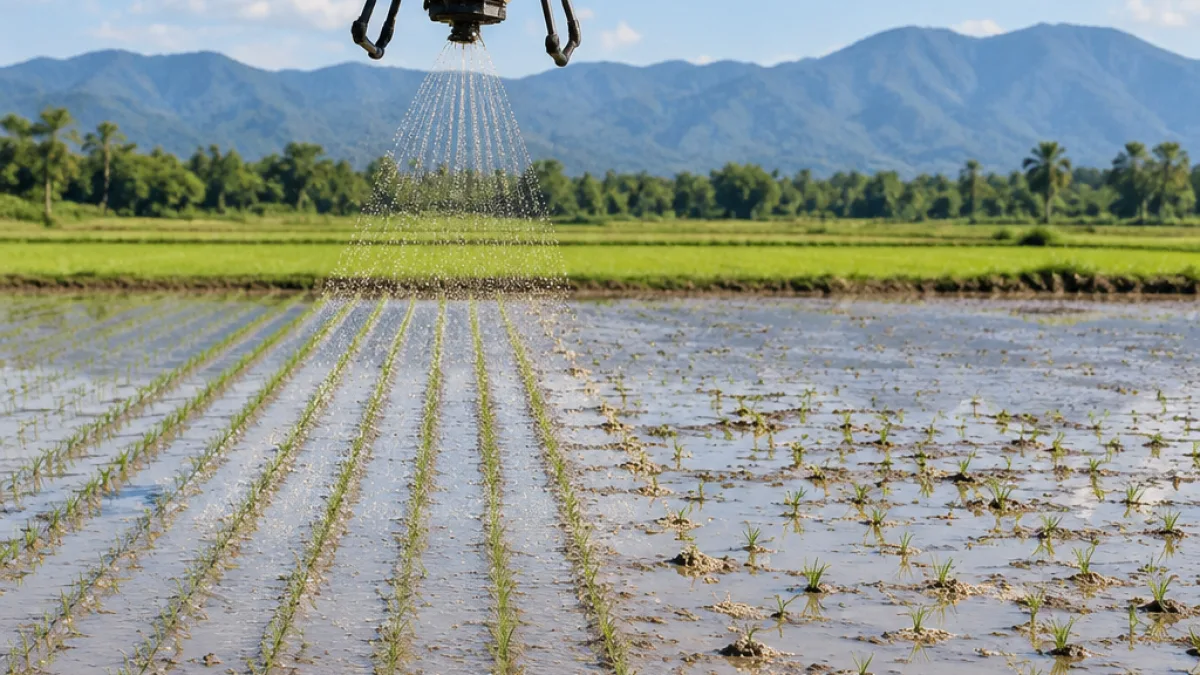
The system addresses a positioning problem created by rotor downwash. When seed falls beneath a drone, the airflow can push it away from its intended landing point. The South China Agricultural University team instead used a pump to propel a slurry of soaked, germinated rice, cellulose powder, bentonite clay and water toward the soil.
The prototype operated at 4.5 mph (2 m/s) and flew 6.6 feet (2 meters) above the mud. The pump discharged the mixture in pulses at 10 Hz, a method the researchers say limited the sideways movement caused by the aircraft’s airflow and produced tighter planting rows.
- The semi-open impeller design scored 0.985 on the team’s weighted comparison index.
- The selected impeller used four blades, measured 76 mm (3 inches) and had a blade width of 22 mm.
- The pump moved 1.12 kg of slurry per second.
- Seed damage was measured at 0.74%, below China’s national standard ceiling of 0.8% for drone rice seeding.
Field results favored the prototype
The team tested the aircraft at a site in Zengcheng district on August 9, 2025. Seed clusters from the prototype landed with a standard deviation of 2.0 cm (0.8 inches) from the target line. A commercial Seaflo DC pump installed on the same aircraft rig recorded 2.9 cm (1.1 inches) in the comparison described by the researchers.
Spacing was also more consistent with the prototype. The coefficient of variation between seed clusters was 13.2%, versus 18.6% for the commercial pump used in the team’s earlier trials. Those measurements provide a narrower technical comparison than the yield result, but together they indicate that the researchers were evaluating both placement accuracy and the agricultural outcome.
| Measure | Prototype system | Comparison |
|---|---|---|
| Field yield | 6,731 kg per hectare | 6,040 kg per hectare |
| Distance from target line | 2.0 cm (0.8 inches) | 2.9 cm (1.1 inches) |
| Spacing variation | 13.2% | 18.6% |
| Cracked seeds | 0.74% | National ceiling: 0.8% |
Research remains focused on the seeding method
Drone rice seeding has commonly relied on broadcasting, in which seed is spread from the aircraft and influenced by the rotor wash. The extracted research describes XAG’s introduction of that approach to rice in 2020 using a granule spreader. The South China Agricultural University project takes a different route by controlling the trajectory of a wet seed mixture before it reaches the field.
The six-person research team, with professor Zhou Zhiyan as corresponding author, published the design last month. The reported results establish the prototype’s performance in the stated field trial, including its yield, placement accuracy and seed-damage rate. They do not by themselves establish performance across other rice varieties, field conditions or growing seasons.