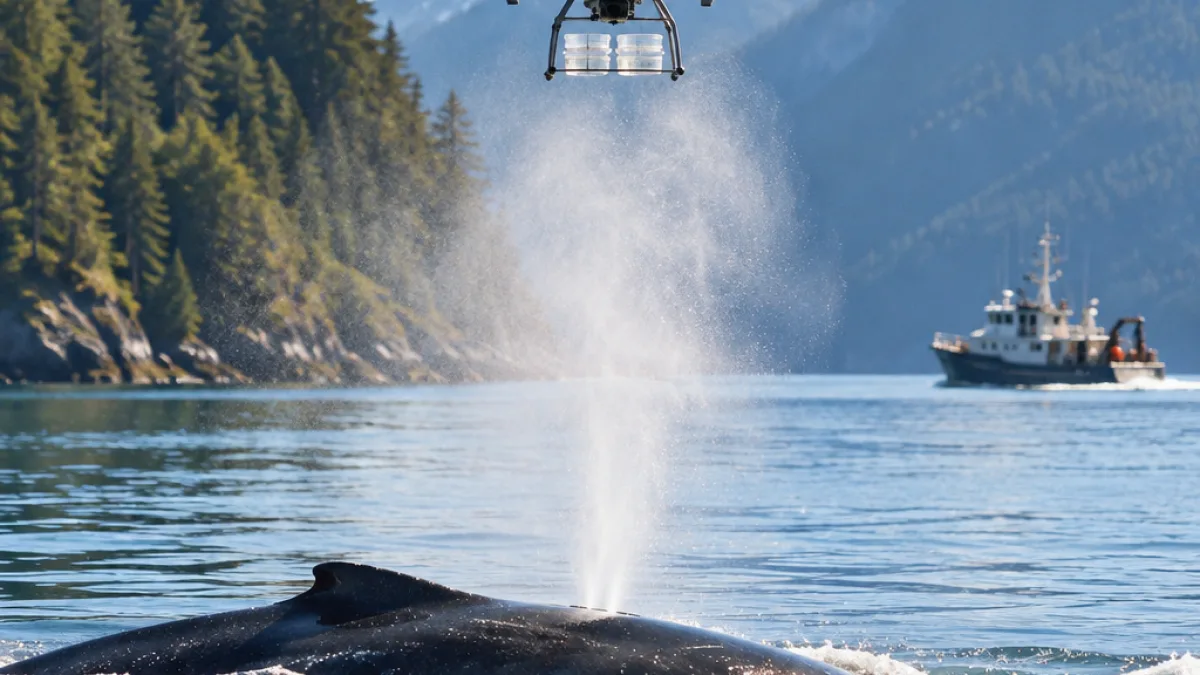
Aerial drones have enabled researchers to complete whole-genome sequencing of humpback whales without using darts, biopsies or close boat approaches, according to an international research team that included scientists from the University of St Andrews in Scotland.
The method uses a small commercially available drone fitted with sterile petri dishes. Researchers flew the aircraft through the exhaled breath of individual whales, collecting material from typically one to six breaths per surfacing. The biological material, commonly described as whale “snot,” provided enough DNA for genomic analysis.
“critical” — the research team’s description of genomic data’s role in conservation
Sampling whales without physical intervention
The team collected 58 blow samples from 26 individual humpback whales in the Kitimat Fjord System in northern British Columbia, Canada. About 84% of the DNA in the blow samples came from the whale itself, according to the researchers.
Repeated samples from the same whales, taken during separate encounters over a period of two years, produced matching genomes. The blow-derived genomes also matched biopsy-derived genomes from the same animals. Those comparisons provided a way to assess whether the airborne sampling method could deliver consistent genetic information without handling or physically contacting the whales.
Genomic data can support several conservation tasks. Researchers can use it to examine population health through measures including genetic diversity and inbreeding. The data can also help identify individual whales for mark-recapture studies, determine sex and estimate population size. Until this work, obtaining a complete whale genome generally required a biopsy collected with a dart, a stranded animal or a historical specimen.
Flight procedures were designed to limit disturbance
The field team selected the whale farthest upwind in a group to reduce the risk of mixing DNA from multiple animals. Resting whales were not sampled, and drone flights were stopped if a whale showed any reaction. These procedures addressed one of the central limitations of conventional biopsy work: reaching whales by boat can require a close approach and may disturb the animals.
- 58 blow samples were collected
- 26 individual humpback whales were sampled
- 84% of the DNA came from whales
- Repeat samples produced matching genomes across two years
The approach is particularly relevant in locations where biopsy sampling is not permitted or is impractical. It also gives conservation researchers a way to gather genetic information from animals that might otherwise be difficult to approach safely. The findings position drone-based blow collection as a field tool for genetic monitoring rather than simply an imaging or observation platform.
By linking a low-contact aerial operation with whole-genome analysis, the research team demonstrated that individual whale identification and population studies can be supported without the physical interventions previously required for complete genomic sequencing.