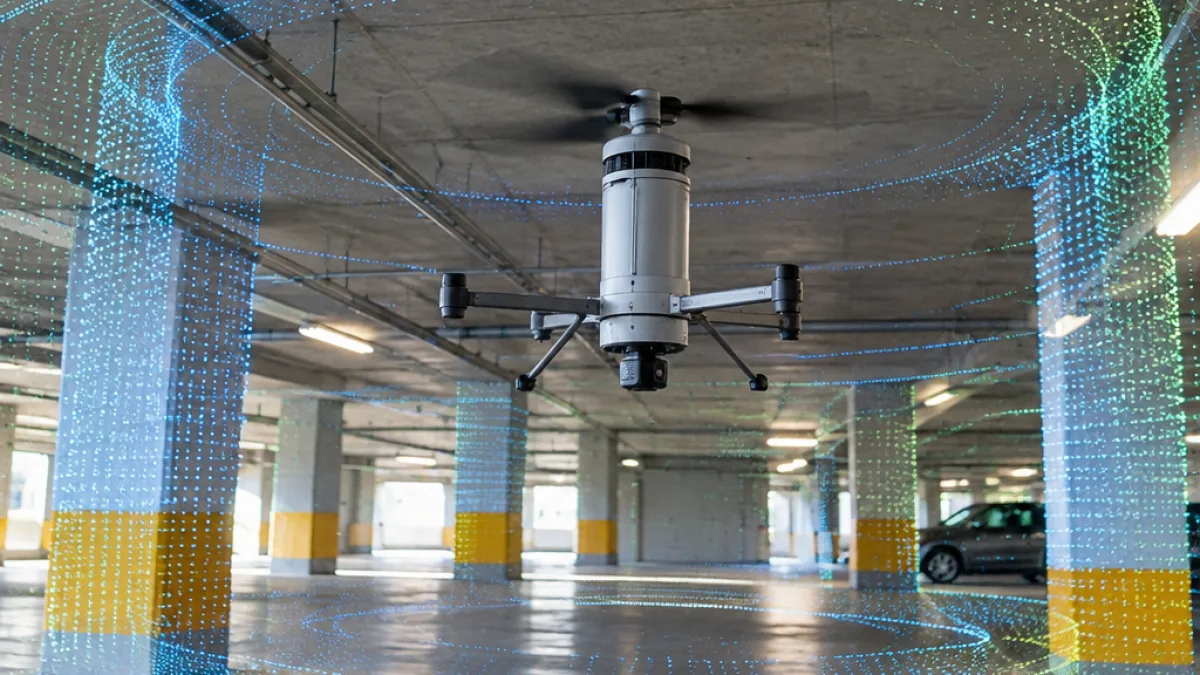
Researchers at The University of Hong Kong have developed an autonomous drone that combines a single propeller, one motor and one LiDAR sensor with a rotating airframe designed to observe its surroundings in every direction. The aircraft, named PULSAR II, is intended for operation in complex environments including forests and underground parking areas.
The team reported that the drone can detect space above, below and around itself while in flight, and maintain controlled flight during collision tests. The findings were published in Nature Communications, according to Mirage News.
A rotating airframe replaces additional sensing hardware
Most quadrotors use four motors to control their flight. Expanding their coverage of the surrounding environment can require additional cameras, LiDAR units or mechanically rotating equipment. Those additions can increase mass and power consumption while also adding complexity to the aircraft.
PULSAR II takes a different approach. Its body continuously rotates during flight, allowing the single LiDAR sensor to scan different directions without a separate rotating gimbal. That movement is integrated into the aircraft's flight behavior rather than treated as an additional payload function.
The aircraft uses a single-motor, two-blade propeller system and a specially designed swashplate-less mechanism. The researchers adjust the rotational speed during each motor revolution to alter the blades' angle of attack. That produces the torque required to change the drone's flight direction while the airframe continues to spin.
“The drone's body naturally rotates during flight, thereby gaining the advantages of high-efficiency flight and omnidirectional sensing that conventional aircraft find difficult to achieve simultaneously.”
That architecture addresses several engineering requirements at once:
- Propulsion: one motor drives the two propeller blades.
- Sensing: one LiDAR unit gathers distance information as the aircraft rotates.
- Control: changes in blade behavior generate the torque needed to steer the aircraft.
- Safety testing: the team reported controlled flight during collision tests.
Research aimed at constrained operating environments
The project is led by researchers from HKU's Department of Mechanical Engineering, including Associate Professor Fu Zhang and Research Assistant Professor Nan Chen. Chen is the paper's first author, while Zhang is the corresponding author.
The operating environments identified by the team place a premium on both obstacle awareness and compact system design. Forests and underground parking facilities can limit visibility and leave little room for maneuvering. In those settings, a drone that can sense in multiple directions without carrying several sensor assemblies may offer a different path for autonomous navigation research.
The reported results remain a research demonstration rather than a commercial deployment announcement. Mirage News described the aircraft's capabilities in the context of flight and collision testing, but the material does not announce production plans, customer operations or a certification program. The significance of PULSAR II is therefore in its aircraft architecture: a single-actuator design intended to reduce hardware while preserving flight control and environmental awareness.