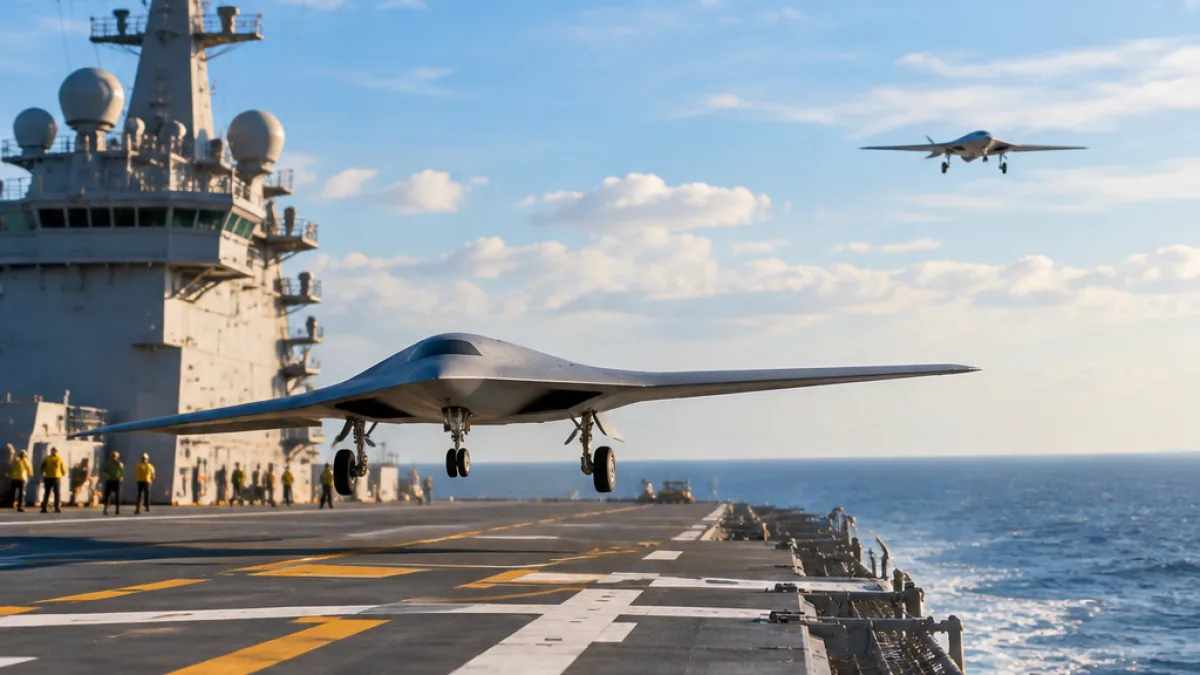
China has tested the GJ-21 stealth unmanned aircraft aboard the Sichuan, the country’s first Type 076 amphibious assault ship, according to state news agency Xinhua. The aircraft completed a takeoff and landing on the vessel, marking a reported first for the platform and demonstrating China’s ability to operate a fixed-wing stealth drone from a large naval ship.
A new role for amphibious ships
Xinhua described the test as a breakthrough for China’s amphibious assault ship program. The GJ-21 is presented as a reconnaissance and strike aircraft, extending the range of missions that could be performed from the Sichuan beyond the ship’s conventional aviation functions. The test also indicates that unmanned aircraft are being incorporated into the design and operating concept of one of China’s newest large naval platforms.
The reported demonstration involved both phases required to operate an aircraft from the ship: departure from the deck and recovery back aboard. The report did not provide performance figures, the number of test sorties, or details of the aircraft’s control arrangements. It did establish that the GJ-21 has reached a stage at which its fixed-wing configuration can be used from the Type 076 platform.
| Aircraft | Platform | Reported role | Test milestone |
|---|---|---|---|
| GJ-21 | Sichuan, a Type 076 amphibious assault ship | Stealth reconnaissance and strike | First reported takeoff and landing aboard the vessel |
Part of China’s broader unmanned-aircraft program
The test forms part of a wider Chinese military modernization effort that includes warships, fighter aircraft, missiles and unmanned systems. The GJ-21 was first shown publicly at a military parade in Beijing last year marking the 80th anniversary of the end of World War Two. During that appearance, the aircraft was displayed carrying different types of weapons.
China’s state-run Global Times cited military expert Zhang Xuefeng as saying that the drone has a considerable combat radius despite having a smaller airframe than the country’s J-35 and J-20 stealth fighters. The report also attributed cost and reuse advantages to the aircraft, contrasting it with systems that cannot be recovered after launch.
“GJ-21 is also low cost and reusable. Unlike hypersonic missiles, it can be recovered and redeployed multiple times.”
Zhang also said the aircraft could deploy small, low-cost glide-guided bombs and argued that repeated recovery and redeployment could support sustained operations. Those statements are claims cited by Global Times and do not constitute independently verified performance data.
What the demonstration establishes
The reported milestone places the GJ-21 within a naval operating concept that combines a large amphibious ship with a stealth unmanned aircraft capable of reconnaissance and strike missions. The available reporting identifies the Sichuan as the test ship and the GJ-21 as the aircraft involved, but does not disclose a planned fleet size, an operational deployment date or details of any weapons integration.
- Aircraft: GJ-21 stealth reconnaissance and strike drone.
- Ship: Sichuan, China’s first Type 076 amphibious assault ship.
- Milestone: Reported first takeoff and landing of the aircraft aboard the ship.
- Program context: China’s continuing investment in naval aviation and unmanned military systems.
For China’s navy, the test provides a publicly reported example of a fixed-wing stealth unmanned aircraft operating from an amphibious assault ship rather than from a conventional land base. Xinhua characterized the event as a development for the Type 076 program, while Global Times emphasized the aircraft’s claimed reusability and potential role in sustained military operations.