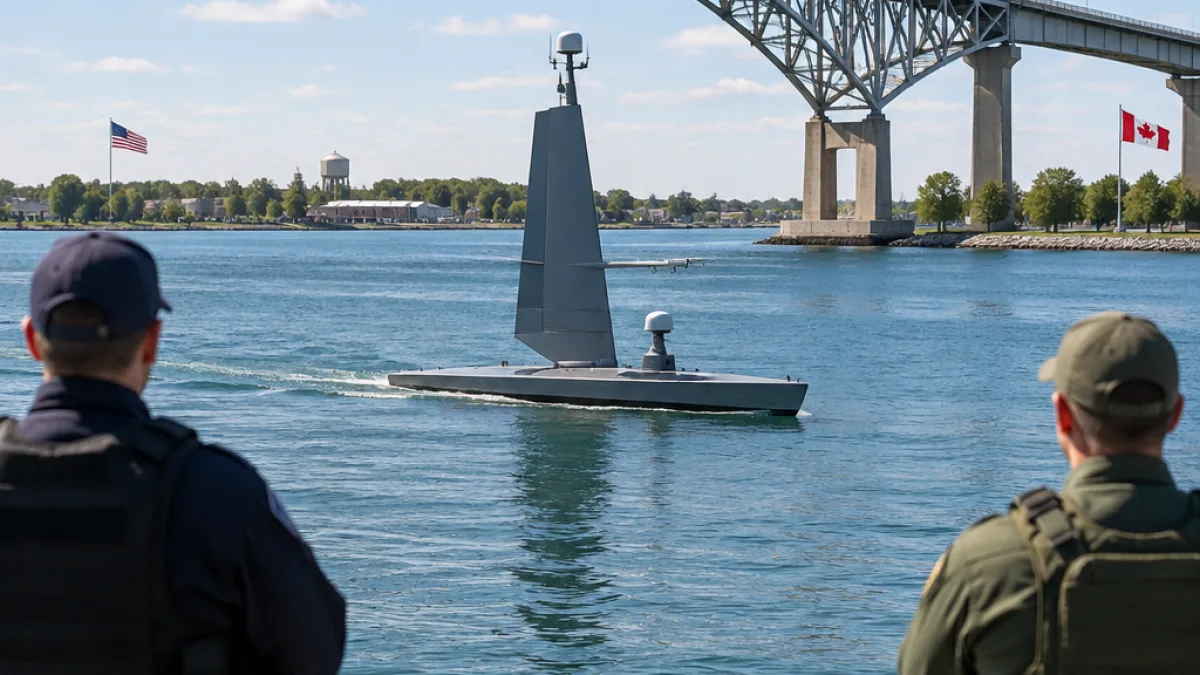
A Saildrone Voyager operated by the U.S. Coast Guard has prompted questions from officials in Sarnia, Ontario, after the unmanned vessel was spotted in the St. Clair River near the border with Port Huron, Michigan. The Coast Guard has been operating six of the drone sailboats on the Great Lakes since May.
The sighting was made by Sarnia Mayor Mike Bradley, who said he initially could not identify the vessel. The river crossing between Sarnia and Port Huron runs beneath the Blue Water Bridge, while the international border itself follows the waterway. Bradley told CBC’s As It Happens that the vessel looked “like something from Mars.”
“a huge slap again to Canada on our sovereignty”
Bradley used that description in comments to CTV News about the deployment. He also said local officials were not informed by U.S. authorities before the unmanned vessel appeared in the river. The mayor told Frequency News that he wants an explanation of what the drones collect and how the information is used.
What the Coast Guard is operating
The vehicle is a 33-foot Saildrone Voyager equipped for extended operations on the water. Its design includes a rigid wing rising about 20 feet above the surface and a keel extending approximately 6.6 feet below the waterline. Saildrone lists the vessel’s working speed as 5 knots and says it can remain deployed for about 100 days between service stops.
Despite its sailing-ship appearance, the Voyager uses a hybrid-electric propulsion system. The wing contributes to propulsion, solar panels recharge its batteries, and the company’s specifications list an electric motor as the primary drive. The Coast Guard’s own description identifies the system as hybrid-electric rather than a conventional crewed sailboat.
Sensor equipment and border questions
The equipment carried by the vessel is central to the concerns raised in Sarnia. The Voyager is described as carrying high-resolution cameras, radar and automatic identification system receivers. Saildrone’s specifications also list an infrared camera. Those systems allow the vessel to act as a persistent sensor platform while operating without a crew on board.
- Operator: U.S. Coast Guard
- Platform: Saildrone Voyager
- Great Lakes deployment: Six vessels operating since May
- Listed endurance: About 100 days between service stops
Neither the exact date of Bradley’s sighting nor a detailed account of the Coast Guard’s mission for that particular vessel was provided in the reporting. CTV News reported the sighting on October 23 and described it as having occurred recently. The episode nevertheless places an unmanned U.S. government sensor platform in a shared international waterway, where local officials are seeking clarity about notification and the handling of collected information.