California, Arizona and Alabama have adopted new restrictions on drone flights around certain event venues, adding another layer of rules for commercial and recreational operators to track. The measures target overflights during events including concerts and monster truck rallies, while differing in the size of venues covered, the distance of the restricted area and the exemptions available to pilots.
The laws are California’s AB 2113, Arizona’s SB 1160 and Alabama’s HB 429. Drone operators and industry advocates have raised concerns that the measures could create a fragmented regulatory environment alongside the FAA’s nationwide airspace rules. The issue is particularly relevant to operators working across state lines, who may need to review state and local requirements in addition to complying with federal regulations.
Three laws, different boundaries
Although the statutes share a general objective, their requirements are not identical. California’s law expressly identifies venues with a capacity of 1,000 or more people. Arizona’s law does not include the same capacity threshold, according to Marshall White, founder of airspace intelligence platform UAShield. That difference can require operators to establish whether a venue meets a particular capacity standard before conducting a flight.
| State | Law | Venue restriction described |
|---|---|---|
| California | AB 2113 | 400 feet from a venue; specifies a capacity of 1,000 or more people |
| Arizona | SB 1160 | One mile from the event site; no capacity threshold identified |
| Alabama | HB 429 | 400 feet from a venue |
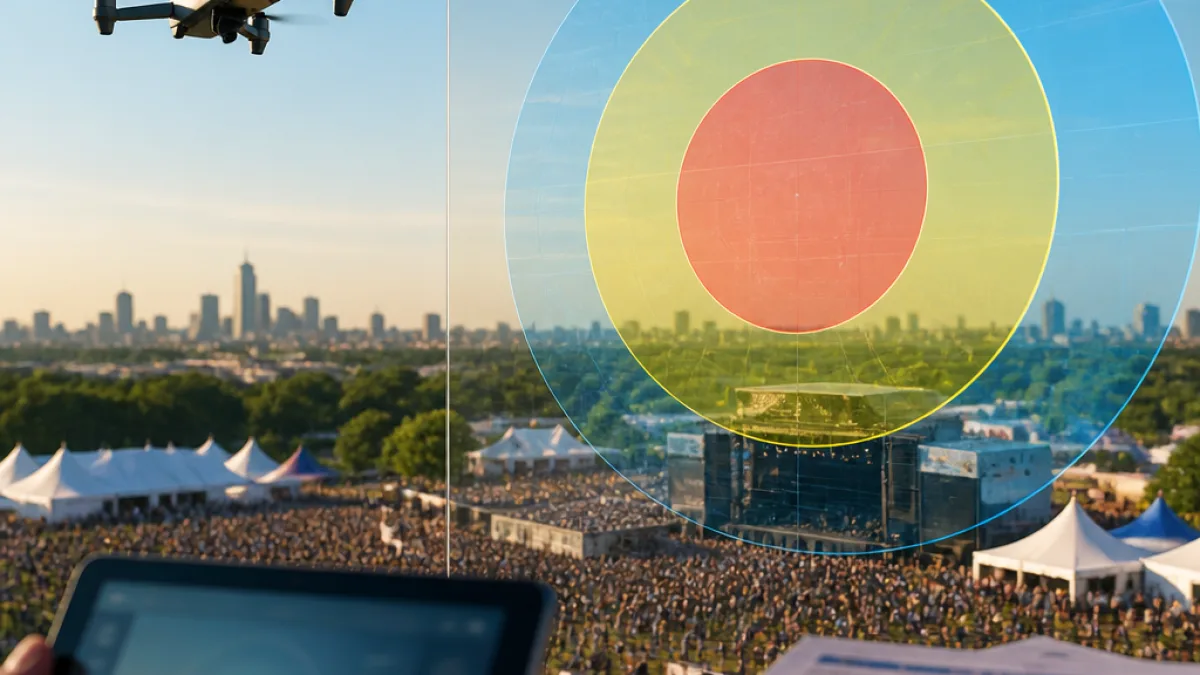
The geographic limits also vary substantially. California and Alabama prohibit flights within 400 feet of a venue, while Arizona establishes a restricted area extending one mile from the site. For a drone business planning work near a ticketed event, the difference can affect flight planning, site assessments and whether an operation can proceed at all under the applicable state law.
“Until fairly recently, following ‘the rules’ generally meant abiding by FAA regulations. In contrast to state and local laws, these are fairly easy to identify and monitor, as federal law is generally standardized in its delivery and availability. That is not at all the case with state and local regulations.”
White said in an email statement that the new measures could create difficulties for both business operators and recreational pilots. He also identified the absence of a capacity threshold in Arizona as a notable difference, saying it places an additional burden on operators who must verify precise seat counts at venues before flying.
Exemptions written into the measures
Each of the three laws includes exemptions for some drone operations. The extracted details identify several examples:
- Operators may be exempt when they have written consent from a person with legal authority over the ticketed entertainment event.
- Employees of a regulated utility may be exempt when performing official business duties.
Those exemptions do not remove the need to determine which law applies to a particular flight, or whether additional FAA requirements govern the operation. Written authorization, utility work and other exceptions must be considered within the specific language of the applicable state measure.
Federal airspace authority remains part of the debate
The new laws have also renewed questions about the relationship between state restrictions and federal authority over navigable airspace. Industry advocates are concerned that some state and local rules could eventually be preempted by federal airspace regulations. That concern is not the same as a determination that any of the three laws has been invalidated or preempted.
For now, the practical effect described by the measures is a more complicated compliance process. Operators must account for the FAA framework as well as state and local restrictions governing flights near event venues. The differences among AB 2113, SB 1160 and HB 429 mean that a procedure used in one state cannot automatically be assumed to apply in another.