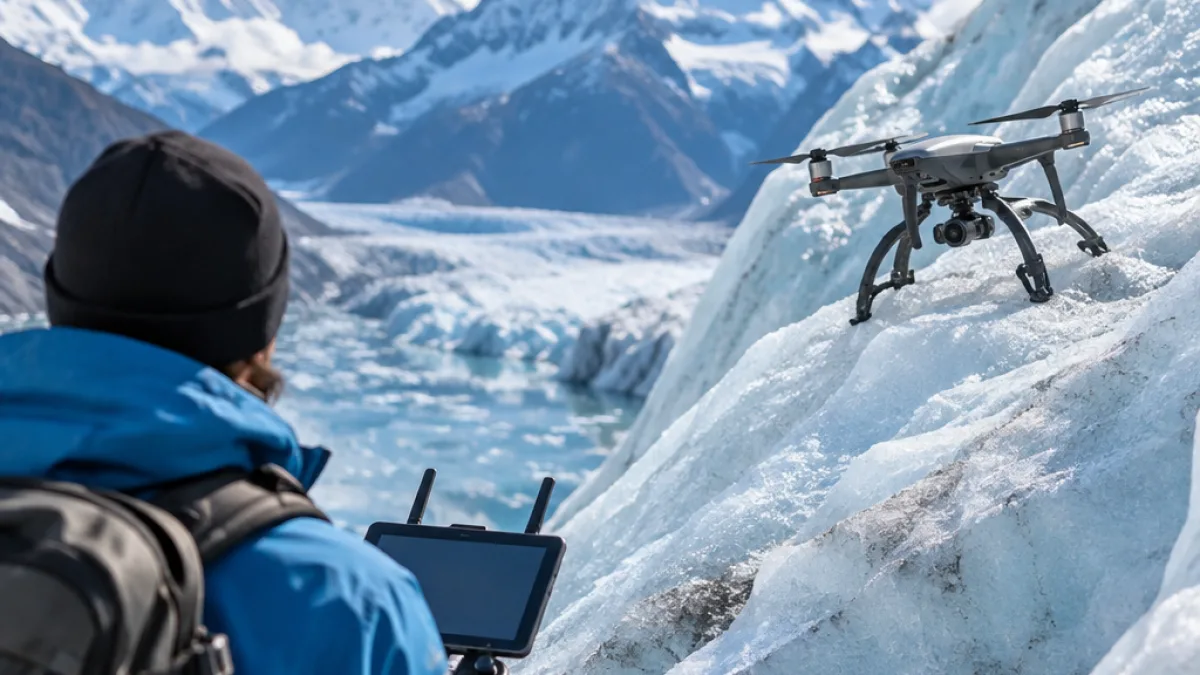
A quadcopter designed to land and remain stationary on steep, irregular ice completed 24 out of 24 reported landings during field trials on Iceland’s Fjallsjökull glacier, according to Thomasnet. The aircraft, called Ice Dart, was developed by researchers at Université de Sherbrooke for operations in environments where finding a stable landing surface can be as difficult as flying.
The 5.84-pound drone was tested on ice slopes reaching 58 degrees, with wind gusts above 18.6 mph. In separate controlled testing, it reached a 60-degree slope while descending at speeds of up to 6.7 mph. Those results address a problem faced by conventional drones: rubber feet can begin to lose their grip on ice at slopes as shallow as 9 degrees, while holding position in a continuous hover consumes battery power.
A landing system built for irregular ice
Ice Dart’s four legs end in opposing, spring-loaded spines modeled on the gripping action of cat claws. The arrangement allows the aircraft to land whether it approaches a slope facing uphill or downhill. After touchdown, an integrated friction system is intended to absorb impact energy and reduce rebound, helping keep the drone in contact with the surface.
The aircraft’s motors then briefly reverse thrust. That action presses the drone against the ice and helps the spines dig into the surface. The design is intended to turn the landing gear into an anchoring system rather than simply a set of feet supporting the aircraft.
| Ice Dart trial detail | Reported result |
|---|---|
| Aircraft type | Quadcopter |
| Weight | 5.84 pounds |
| Field location | Fjallsjökull glacier, Iceland |
| Field landings | 24 of 24 completed |
| Field slope | Up to 58 degrees |
| Wind during field trials | Gusts above 18.6 mph |
| Controlled-test slope | 60 degrees |
From flying platform to fixed sensor
Once it has perched, Ice Dart can reduce its power consumption and operate as a stationary sensing platform. The applications identified for the aircraft include iceberg tracking, environmental monitoring and maritime safety. Remaining on the surface instead of hovering allows the drone to preserve energy while collecting information from a fixed position.
The approach is particularly relevant to fieldwork around glaciers and icebergs, where landing areas may be narrow, angled or unstable. A drone that can secure itself to ice can serve as a sensor without requiring a pilot to maintain constant flight throughout an observation period. The reported trials, however, concerned landings on a glacier rather than autonomous operations on moving ice.
Autonomy remains the next step
The Iceland tests still required a human pilot. According to Thomasnet, autonomous landings on drifting icebergs remain a future development step, meaning the reported performance does not yet demonstrate a fully autonomous sensing mission in that environment.
That distinction matters because an iceberg introduces movement in addition to slope, wind and surface irregularity. Ice Dart’s field results establish that the landing mechanism worked across the reported glacier trials, but the aircraft’s ability to identify, approach and secure itself to a drifting target without a pilot has not been demonstrated in the information published by Thomasnet.
- Field result: 24 successful reported landings on slopes up to 58 degrees.
- Environmental role: A perched aircraft can function as a lower-power sensor for iceberg tracking, environmental monitoring and maritime safety.
- Current limitation: The glacier trials required a human pilot, while autonomous landings on drifting icebergs remain future work.