
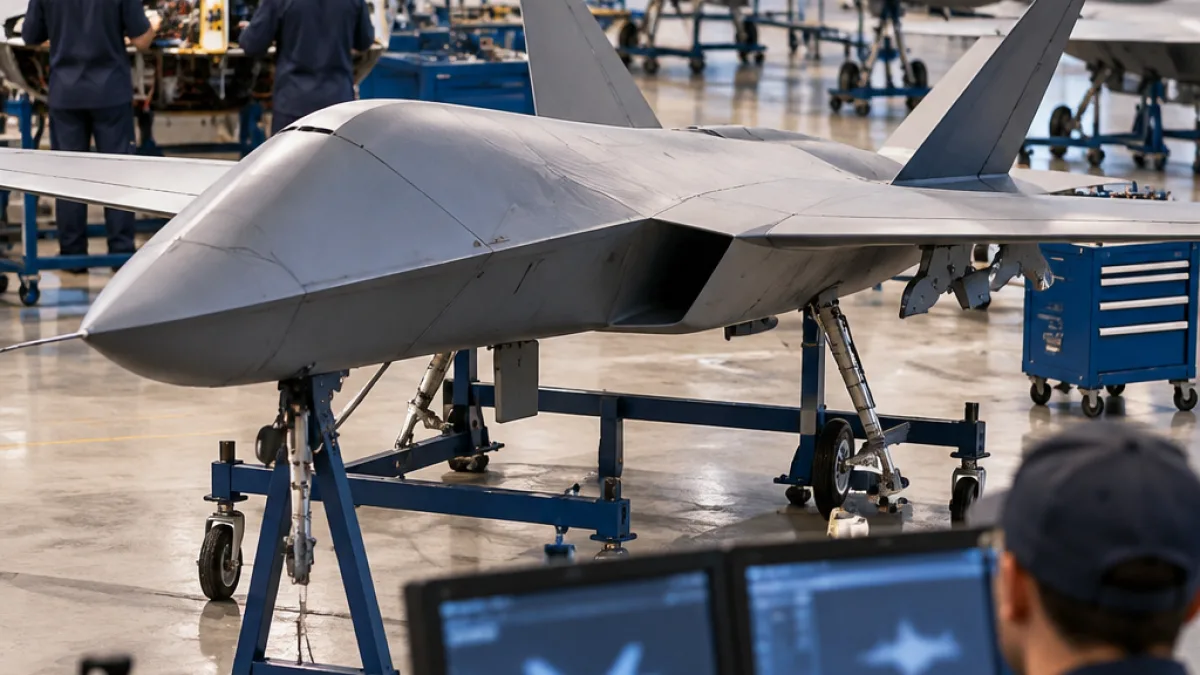
Pakistan’s Arrow-1 has moved from public display models to apparent factory assembly, according to newly circulated footage examined by Defence Security Asia. The development has drawn attention to a ground-launched jet drone program linked to the Pakistan Air Force, although the imagery does not establish that the system has entered operational service.
The footage was associated with a visit by Pakistan’s air chief to Uzbekistan and showed Arrow-1 airframes in a manufacturing environment. A separate promotional video released by the Pakistan Air Force also featured the aircraft. Together, the material provides stronger public evidence of the airframe and its apparent production activity than earlier display material, while leaving major questions about testing, acceptance and deployment unanswered.
What the imagery shows
Arrow-1 is presented as a one-way attack drone with a faceted airframe and an apparent jet intake. Its shape has been compared with the American AGM-158 Joint Air-to-Surface Standoff Missile, but the program’s reported significance rests on its proposed operating concept rather than on visual similarity. The aircraft is designed around ground launch and would represent a separate expendable capability alongside Pakistan’s slower propeller-driven weapons and established cruise missile families.
Factory imagery alone cannot confirm that a complete weapon system is being produced. A visible airframe is only one element of a deployable system, which would also require propulsion, guidance, acceptance testing and an organization able to operate and sustain it. Defence Security Asia therefore described the footage as a reported production milestone, not proof that Arrow-1 has been fielded.
“The stronger public evidence concerns the airframe and the apparent move into manufacturing.”
Defence Security Asia also cautioned that claims about terrain-hugging flight and the ability to penetrate advanced air defenses remain unverified. No flight profile, signature measurements or representative test results were identified in the report. Those gaps make it impossible to assess the drone’s actual performance or the extent to which the program has progressed beyond industrial assembly.
Why the program is attracting attention
The ground-launched design could give Pakistan a strike option that does not require the use of crewed aircraft for every mission. If the system reaches service in meaningful numbers, it could add another category to the inventory that Indian air-defense planners must consider. The practical importance of that possibility would depend on production volume, reliability, sustainment and integration with existing forces—none of which is established by the factory footage.
- Program: Arrow-1
- Reported operator: Pakistan Air Force
- Industrial organization: National Aerospace Science and Technology Park, or NASTP
- Status shown publicly: Apparent factory assembly; operational deployment not confirmed
NASTP’s reported involvement gives the program an industrial dimension as well as a military one. The organization’s role could indicate an effort to expand Pakistan’s ability to integrate and produce unmanned strike systems domestically, but the available imagery does not show how far that effort has advanced or whether the aircraft has completed the testing required for service.
For regional observers, the immediate development is therefore the apparent transition from exhibition material to manufacturing activity. Whether Arrow-1 becomes an operational capability will depend on evidence from flight testing, production completion and formal deployment. Until that evidence emerges, its range, flight behavior, survivability and force structure remain undetermined.