Ohio State University has installed remotely operated drone stations on three campus buildings, adding an aerial response capability to its Department of Public Safety. The system is part of the university’s Drones as a First Responder program and is intended for use on priority calls, university spokesperson Dan Hedman said.
Three buildings now host drone stations
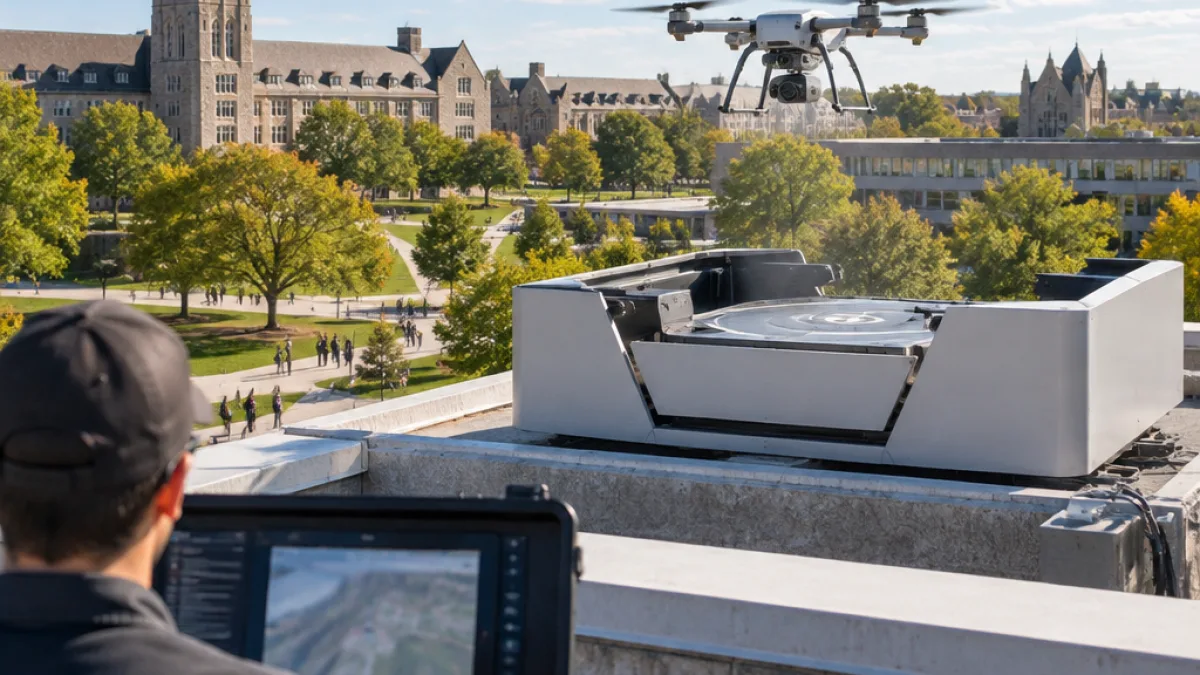
The university placed the systems in March on the Journalism Building, Blankenship Hall and the WOSU Public Media building. Each station is a docking enclosure that houses a drone and allows it to be deployed remotely by an operator. University Hall, Sullivant Hall and Ohio State’s Recreation and Physical Activity Center were also considered, according to records.
Hedman said building locations were selected using several operational criteria:
- Geographic location across the university’s facilities
- Clearance on the rooftop
- Access to data and electrical power
The Blankenship Hall location is also where Ohio State Police are based. The arrangement places the aircraft at multiple points around the university rather than relying on a single launch site, while keeping the systems connected to public-safety operations.
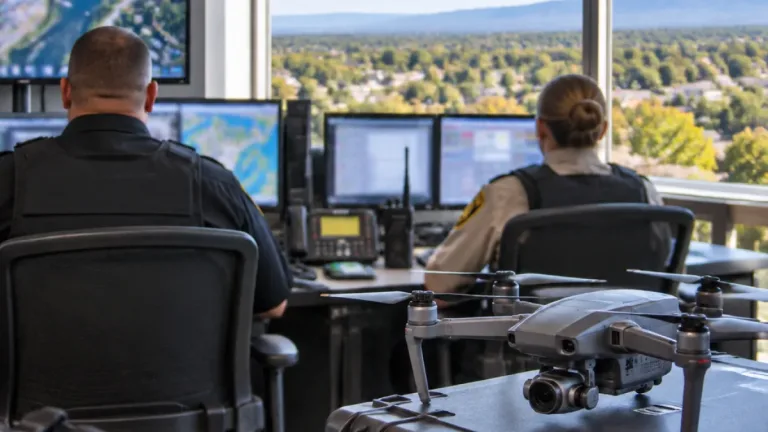
“These are small drones with a camera used only on priority calls to offer faster response times and enhanced situational awareness,” said Dan Hedman, an Ohio State University spokesperson.
University says aircraft can reach scenes in under 90 seconds
Ohio State said the drones can put “eyes on the scene” in under 90 seconds, allowing public-safety personnel to obtain visual information before or during a response. The university describes that capability as a way to support de-escalation and help protect lives, rather than as a replacement for police or other emergency personnel.
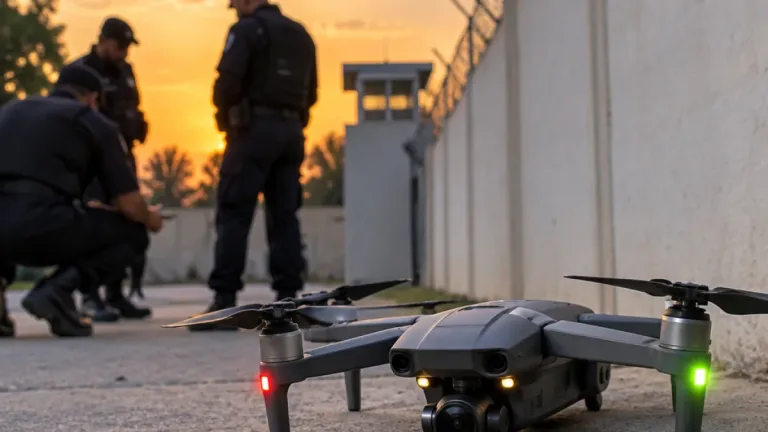
The stations are roughly 4.5 feet high, according to information published by Skydio. The aircraft can deploy in less than 40 seconds, reach speeds of up to 45 miles per hour and remain airborne for up to 40 minutes, also according to Skydio’s website. They can be operated with a controller or browser, or fly autonomously using onboard artificial intelligence.
| Program detail | Reported information |
|---|---|
| Operator | Ohio State University Department of Public Safety, including the Ohio State Police Division |
| Stations | Journalism Building, Blankenship Hall and WOSU Public Media |
| Deployment purpose | Priority calls and faster situational awareness |
| Contract | $1.16 million over five years, beginning in 2025 |
Use is limited to priority calls
The university’s stated policy limits the drones’ use to priority calls. That restriction is significant because it defines the program as a targeted public-safety tool rather than continuous aerial monitoring of campus activity. The reported function is to provide a live or near-live view of an incident so response teams can assess conditions before arriving.
The $1.16 million, five-year contract, which began in 2025, covers more than the aircraft themselves. The agreement includes equipment, training for drone operations and software licenses. Ohio State’s program therefore combines rooftop infrastructure, aircraft, operator training and the digital systems used to connect the drones with the university’s public-safety operation.
The deployment reflects a broader move by police departments, universities and other public-safety organizations toward docked aircraft that can be launched without transporting a drone to each incident. At Ohio State, however, the program’s published purpose remains specific: dispatching small camera-equipped drones to priority calls to improve response speed and situational awareness for campus public-safety teams.