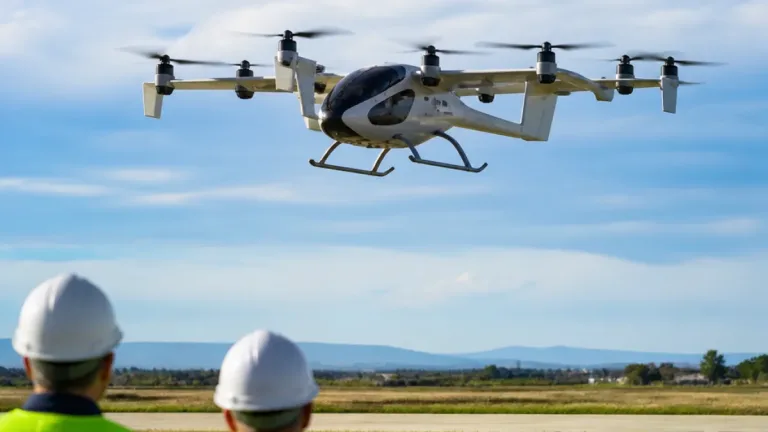

The Federal Aviation Administration is signaling that electric vertical takeoff and landing aircraft will face substantial limits if manufacturers seek to operate revenue-generating flights before completing type certification. Any such activity would take place under the FAA’s national eIPP pilot program, not as a substitute for the agency’s certification process.
Caitlin Locke, the FAA’s Deputy Associate Administrator for Safety Oversight and Certification, told FlightGlobal that requests for commercial operations involving aircraft without type certification would require rigorous review and a clear justification based on what the FAA could learn from the activity. Locke said the agency has developed a tiered framework for evaluating those requests, although no manufacturer has submitted one.
“There’s going to be conditions and limitations placed on it, and the easier path would be just to complete the type certification.”
Locke also characterized an aircraft operating in that circumstance as experimental, underscoring the distinction between a limited pilot-program operation and a certified commercial air service. The details of the FAA’s decision framework have not been published.
Certification remains the clearest route
FlightGlobal reported that the FAA’s position makes completing type certification the most straightforward path for manufacturers seeking broader commercial operations. The agency’s approach leaves room for carefully controlled activity, but it does not establish a general authorization for passenger service by uncertified eVTOL aircraft.
The eIPP was created after an executive order signed by President Donald Trump in June 2025 aimed at advancing the drone and advanced aircraft industry in the United States. According to an FAA fact sheet, the program is based on partnerships between government entities and companies and is not intended to bypass certification standards.
Eight partners selected for the pilot program
In March 2026, the FAA selected eight partners for the initiative. They included the departments of transportation of Florida, Texas and Utah, along with the Port Authority of New York and New Jersey. The program therefore combines federal oversight with state and regional participation as the agency examines potential advanced-aircraft operations.
- The FAA says commercial requests involving uncertified aircraft would undergo rigorous review.
- Operations could carry conditions and limitations tied to the FAA’s decision framework.
- No manufacturer had submitted a request under that framework when Locke spoke to FlightGlobal.
- Flights currently operating under the program have primarily involved cargo and medical supplies, according to reports in The Air Current and Aerospace America.
The FAA’s stance has developed as the agency expands operational opportunities within the pilot program while maintaining certification requirements. Reports by The Air Current and Aerospace America described increasing flexibility for manufacturers, but the agency’s position remains that uncertified commercial activity must be limited and justified by its value to the program.
For eVTOL developers, that places the emphasis on the certification process rather than treating the pilot program as an alternative route to market. The FAA’s comments also make clear that any pre-certification commercial operation would be assessed individually, with its scope determined through conditions and limitations that have not yet been publicly detailed.