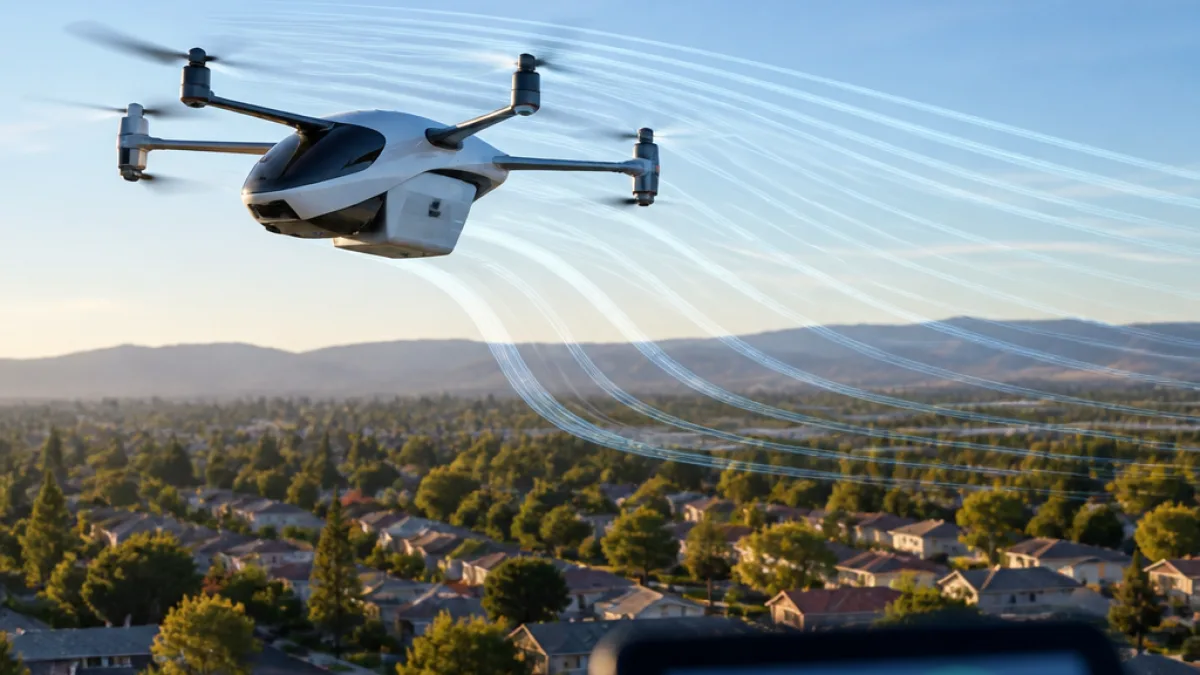
Zipline says a new flight profile is now deployed across its delivery fleet, reducing modeled sound exposure per flight by 68% and peak loudness by 24% compared with its 2025 fleet. The company calls the system sound-optimized dynamic flying.
The system replaces a fixed flight path with one calculated during the mission. On takeoff, the aircraft measures the wind and combines that reading with Zipline’s acoustic model to select how it climbs, cruises and descends. The company says the aircraft uses wind and gravity to build speed and slow down, reducing the need for motor power during those transitions.
Quieter transitions between hover and cruise
Zipline’s Platform 2 aircraft begins its flight on hover propellers before rotating onto a fixed wing. Once it reaches cruising speed and altitude, the aircraft can operate with all but one motor shut down, according to Zipline. The transition between the two flight modes is therefore a central focus of the revised profile.
The aircraft dips its nose after takeoff to accelerate before moving onto the wing. Near the end of a delivery, it pitches up to reduce speed rather than using its motors to brake. Zipline says the change moves the aircraft onto the wing more quickly and allows it to remain there for roughly 50% longer during each flight.
- Modeled sound exposure per flight: 68% lower than the 2025 fleet
- Modeled peak loudness: 24% lower
- Median flight time: 53 seconds shorter
- Energy use per flight: 21% lower
Zipline said the sound and loudness figures are based on internal modeling. The company has not published ground-measured decibel readings for the new flight profile. That distinction matters for communities evaluating the practical effect of delivery operations, because modeled reductions do not by themselves establish how aircraft will sound at a particular home, business or delivery location.
“We want people to love having Zipline available, not just tolerate it, and that starts with making it the quietest way to get a delivery. We’ve spent years pushing the limits of engineering to make that true.”
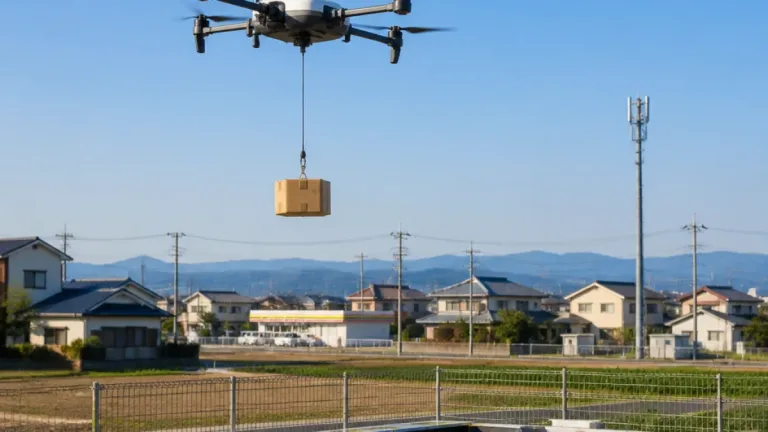
Keenan Wyrobek, Zipline co-founder and chief technology officer, said the company’s work combines the dynamic flight profile with earlier aeroacoustic developments, including proprietary quiet propellers. Zipline also uses a delivery architecture that keeps the aircraft about 330 feet (100 meters) above the ground while a package descends on a tether.
Delivery altitude and aircraft operation
Zipline says that delivery altitude is higher than the approximately 32 feet (10 meters) cited for other delivery-drone services. The aircraft does not need to descend to the recipient during the final handoff, allowing the fixed-wing platform to continue its higher-altitude flight while the package is lowered.
The company said the revised flight behavior cuts energy use by 21% per flight and shortens the median mission by 53 seconds. Those changes are operational claims from Zipline, alongside the modeled acoustic results, rather than measurements independently reported by an aviation authority or an outside testing organization.
For delivery operators, the update addresses several parts of the same flight: the sound produced during the hover-to-wing transition, the energy required to complete a mission and the time spent in the aircraft’s more efficient fixed-wing mode. Zipline has now characterized the approach as a fleetwide capability, making it part of the company’s operating profile rather than a limited aircraft trial.