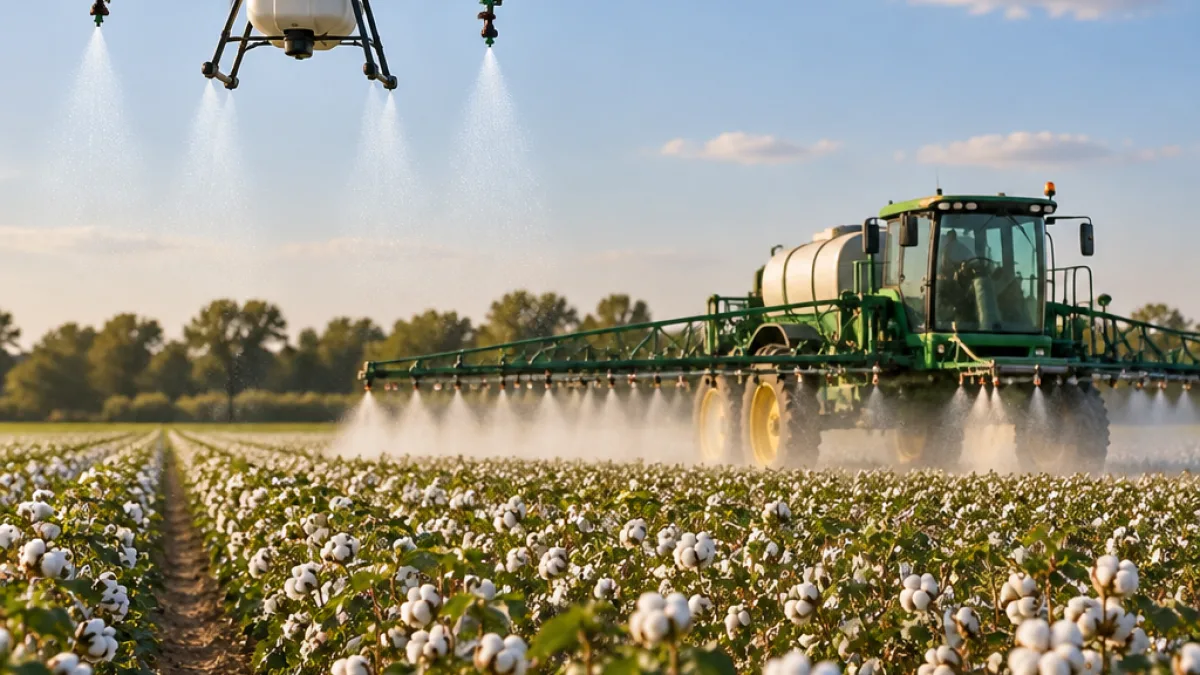
Spray drones produced cotton defoliation results comparable with a ground rig in Auburn University field trials, despite depositing less spray and distributing it less evenly through the plant canopy. The findings, reported by Auburn precision agriculture specialist Simer Virk in a November 16 Farm Press column, could inform how growers assess lower-volume aerial applications of harvest aids.
The drone applied a three-way defoliant mixture at 3 and 5 gallons per acre (28 and 47 liters per hectare). The ground equipment used the same mixture at 10 gallons per acre (94 liters per hectare). Across the study years, Auburn reported similar defoliation, lint yield and fiber quality for both drone application rates and the ground pass.
Lower coverage did not produce a weaker crop result
Auburn measured spray deposition at the upper, middle and lower sections of the cotton canopy. The ground rig produced greater coverage at each level. Virk attributed that difference to the ground machine’s higher application volume and its boom, which traveled closer to the plants.
The research team assessed coverage with water-sensitive paper placed inside the canopy, according to an abstract submitted by Auburn’s Shubhdeep Singh for the CANVAS 2026 conference. The drone also produced a less uniform pattern across its swath. A ground boom spaces its nozzles at regular intervals, while the drone’s spray pattern formed a broad bell-shaped distribution that remained variable when adjacent passes overlapped.
Propeller downwash helped move spray into the crop, but the effect weakened as the aircraft flew higher or faster, Virk reported. Increasing the drone’s application rate from 3 to 5 gallons per acre improved plant coverage, particularly in the upper canopy. Even so, the lower-volume treatment delivered similar agronomic results in the Auburn trials.
| Application method | Defoliant volume | Reported result |
|---|---|---|
| Spray drone | 3 gallons per acre | Similar defoliation, lint yield and fiber quality |
| Spray drone | 5 gallons per acre | Improved coverage compared with the lower drone rate |
| Ground rig | 10 gallons per acre | Greater and more even canopy coverage |
Trial rates were below Alabama’s 2020 guidance
The results also sit below the rates in Alabama Extension’s cotton defoliation guide, which was posted in 2020. The guide recommends at least 15 gallons per acre by ground and 5 gallons per acre by air for harvest-aid applications. It does not specifically address drones. Auburn’s 3-gallon-per-acre drone treatment was therefore 2 gallons below the guide’s aerial figure, while the ground trial also used less than the guide’s recommended ground rate.
According to Virk’s report, measurements of defoliation, desiccation, regrowth and open bolls were similar for both drone volumes and the ground application in every year of the study. The findings do not eliminate the coverage difference between the two methods, but they show that coverage readings alone did not translate into a measurable disadvantage in the reported cotton outcomes.
- The drone used 3 or 5 gallons of mixture per acre, compared with 10 gallons for the ground rig.
- Ground equipment produced higher and more uniform coverage at the upper, middle and lower canopy levels.
- Auburn reported similar defoliation, lint yield, fiber quality, desiccation, regrowth and open-boll results across the tested methods.