
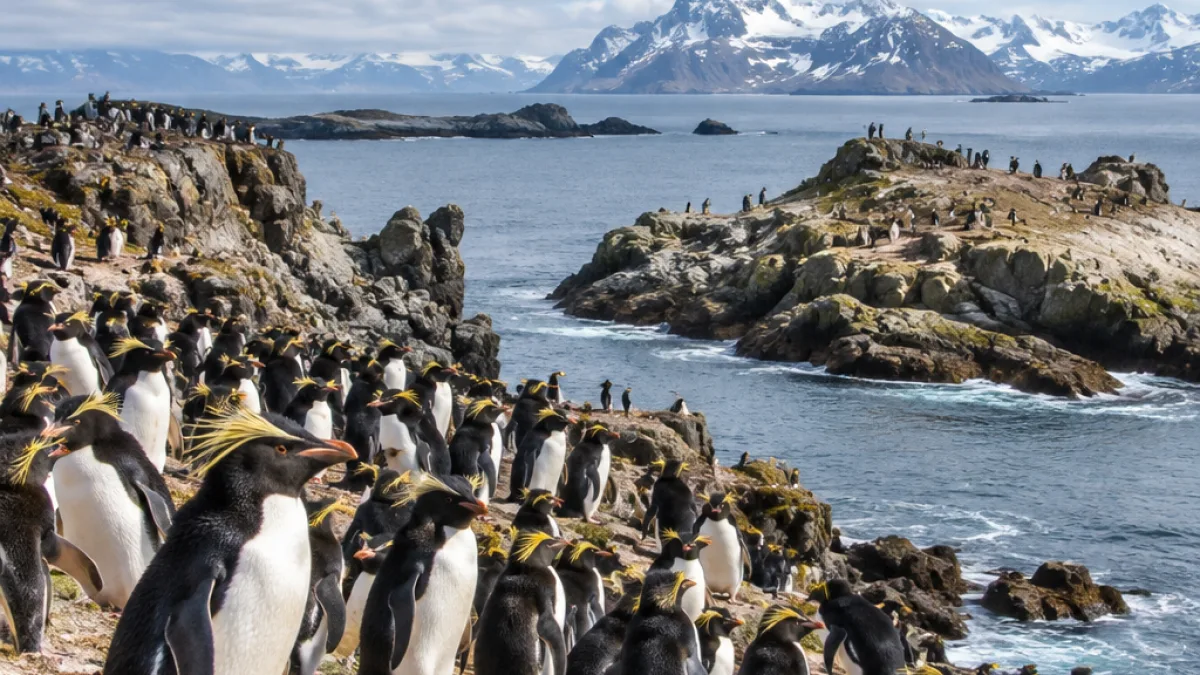
A drone survey of New Zealand’s erect-crested penguins has found that the species’ two remaining breeding groups are following sharply different trajectories. Researchers from the University of Otago counted about 57,600 breeding pairs across the Bounty and Antipodes islands, but comparisons with historical records showed that one population has remained broadly stable while the other has fallen by more than 40% since 1995.
The study, published in PLOS ONE, covered both island groups between 2022 and 2024. Researchers used drones to photograph the breeding colonies and count the birds, producing the first comprehensive population survey for the entire species. The islands are roughly 800 kilometers southeast of New Zealand’s South Island and are the only places where erect-crested penguins breed.
A complete count across two remote island groups
The Bounty Islands, which cover only about 50 hectares, contained approximately 27,800 breeding pairs. The much larger Antipodes Islands held about 29,800 pairs. Although the Antipodes group had traditionally been regarded as the species’ main stronghold, the drone-based count and historical comparison produced a different picture.
| Island group | Current estimate | Trend identified by the study |
|---|---|---|
| Bounty Islands | About 27,800 breeding pairs | Essentially unchanged for at least 25 years |
| Antipodes Islands | About 29,800 breeding pairs | Down more than 40% since 1995 |
Dr. Thomas Mattern led the work for the University of Otago’s Tawaki Project. The results challenge the assumption that the larger island group necessarily provides the more secure population base. Because the survey covered every breeding colony on both groups, the researchers were able to compare the two populations using the same aerial method rather than relying on separate or incomplete historical counts.
Predation pressure at shrinking colonies
The researchers identified several overlapping pressures on the Antipodes population. One is predation by skuas, subantarctic birds that take penguin eggs and chicks. As colonies became smaller, the protection associated with large nesting groups weakened, according to the study’s account. That may have contributed to further losses and to the breakup of colonies into smaller groups.
Dr. Klemens Pütz, a co-author from the Antarctic Research Trust, also linked the situation to the decline of Eastern Rockhopper penguins on the Antipodes Islands. That species experienced a severe collapse during the second half of the 20th century, likely associated with warming ocean waters, and fewer than 1,000 breeding pairs now remain there. Pütz suggested that the loss of Rockhopper penguins may have left skuas relying more heavily on erect-crested penguin eggs and chicks.
Why the aerial method matters
The survey provides a common baseline for a species spread across remote islands that are difficult to monitor consistently from the ground. Its key findings are:
- The Bounty Islands population has held steady for at least 25 years.
- The Antipodes Islands population has declined by more than 40% over three decades.
- Drones enabled researchers to document every breeding colony across both island groups between 2022 and 2024.
- The results overturn the long-standing assumption that the Antipodes Islands are the species’ most secure population center.
For conservation teams, the distinction between the two island groups matters because a single total for the species would conceal the decline at the Antipodes Islands. The drone counts separate the populations and provide a repeatable way to measure changes in colony size, while the study’s analysis points to predation and wider ecological changes as pressures requiring further attention.