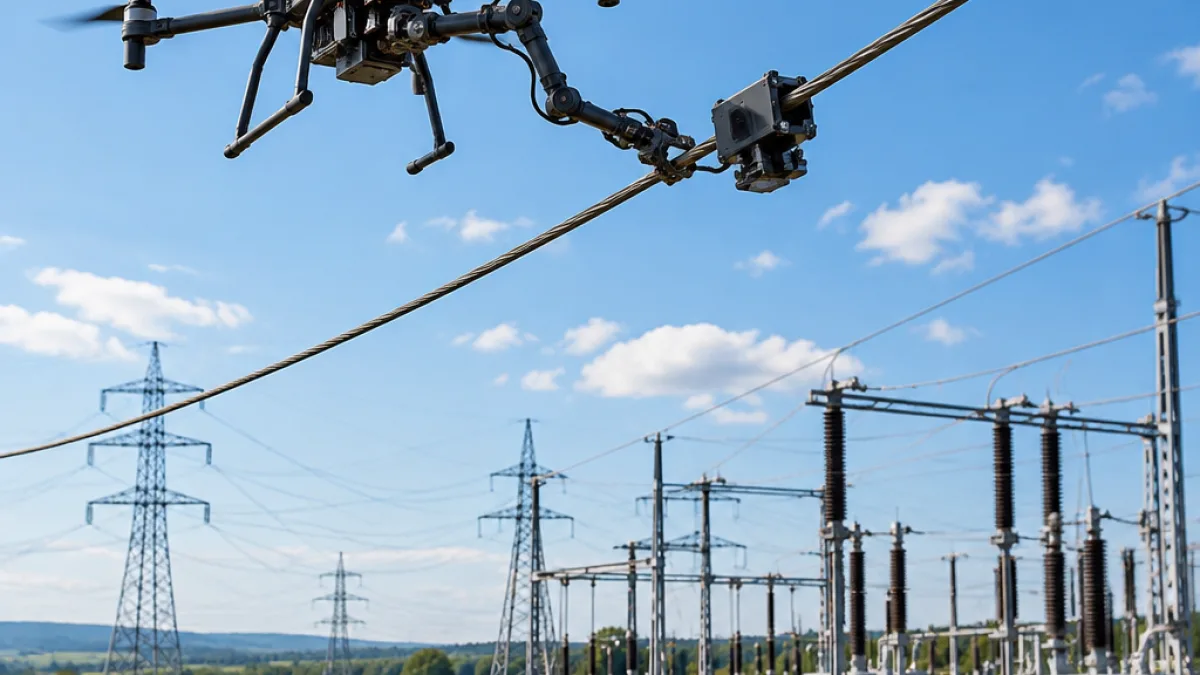
SSEN Transmission has used a drone to install sensors on a live electricity transmission line at Kintore Substation in Aberdeenshire, in what the company described as the first deployment of its kind in the United Kingdom. The operation attached Dynamic Line Rating (DLR) sensors to an overhead conductor while the circuit remained in service.
The work addresses a practical constraint in power-network maintenance: installing monitoring equipment on transmission infrastructure without shutting down the line. SSEN Transmission said the sensors were flown to the conductor and clamped into place remotely, allowing the company to add the equipment without taking the circuit out of service for the installation.
Using live conditions to rate line capacity
DLR provides information about how much electricity a line can safely carry under current conditions. Rather than relying only on seasonal ratings based on conservative assumptions, the system accounts for factors including temperature and wind. When conditions permit, that can allow more electricity to move through existing infrastructure.
For a network operator, the value is tied to the asset already in place. Better information about conductor conditions can help identify when available capacity is higher than a fixed seasonal limit, potentially reducing the amount of renewable generation restricted by network constraints. SSEN Transmission said the Kintore project forms part of its work to improve network efficiency as Scotland transitions toward a low-carbon energy system.
“Using a drone to install these sensors while the transmission line remains live means we can deploy Dynamic Line Rating technology without taking that circuit out of service for the installation.” — Niall McDonald, project director at SSEN Transmission
Two circuits are planned for the project
SSEN Transmission plans to install around 32 sensors across two circuits at Kintore. The project follows the introduction of DLR north of Beauly and extends the company’s use of the technology for managing transmission capacity.
- Asset: an overhead electricity transmission conductor at Kintore Substation in Aberdeenshire
- Drone task: flying DLR sensors to the conductor and clamping them into position remotely
- Planned deployment: around 32 sensors across two circuits
- Operational condition: the circuit remained live during installation
The approach combines an unmanned aircraft operation with a sensor system that remains on the power asset. The drone is being used as an installation method rather than as the monitoring device itself. That distinction matters for infrastructure owners: the immediate operational result is the placement of equipment without requiring a circuit outage, while the longer-term result is access to real-time line data.
SSEN Transmission estimates that similar interventions helped save consumers almost £300 million in 2025/26 by reducing costs associated with electricity network constraints. The estimate was provided by the company in connection with its wider DLR work; it was not presented as a saving generated solely by the Kintore installation.
McDonald said the method could make DLR deployment easier and more flexible across the company’s network. For transmission operators, the project illustrates a narrowly defined but significant use of drones: placing hardware on energized infrastructure while limiting the need for conventional access arrangements and avoiding an interruption to the circuit during the installation.