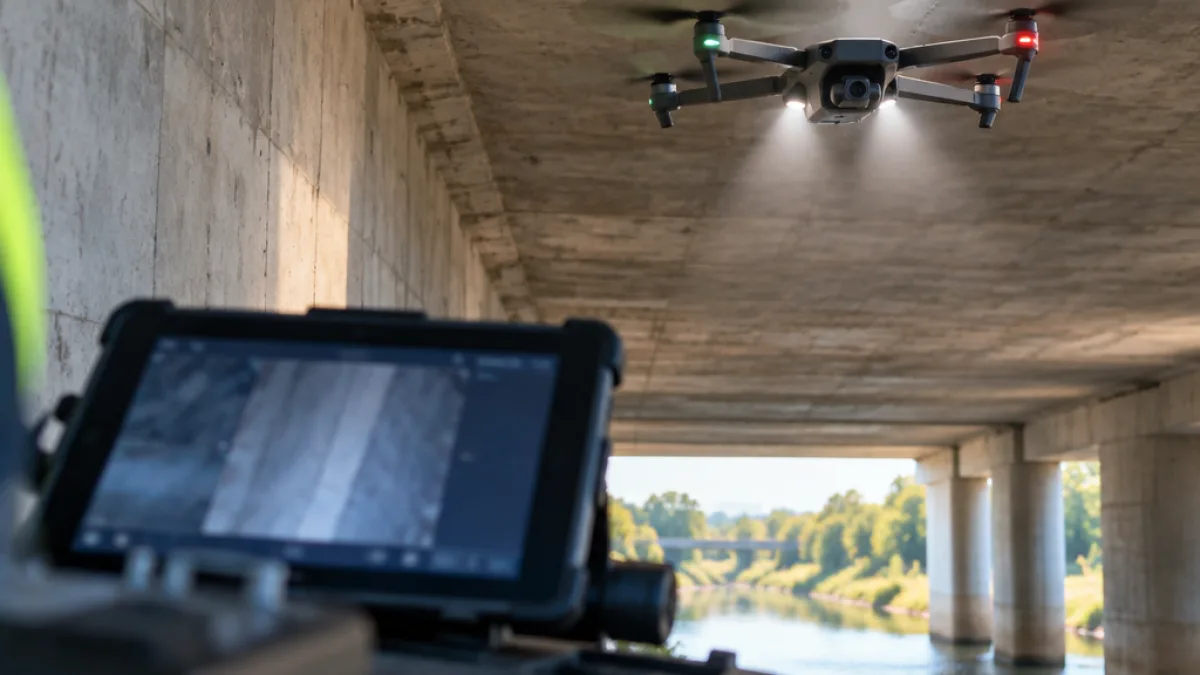
Researchers at Ruhr University Bochum have developed an autonomous drone intended to inspect concrete bridges in areas that can be difficult or dangerous for human inspectors to reach. The system is designed to navigate narrow, poorly lit spaces, identify small cracks and record inspection data directly on an SD card.
The project is being developed by research associates David Müller, MSc, and Raphael Dyrska, PhD, along with their team. The researchers say the unmanned aerial vehicle combines autonomous flight with image-based assessment of concrete surfaces, allowing it to examine parts of bridge structures without requiring inspectors to work directly in those confined areas.
Autonomous mapping for confined spaces
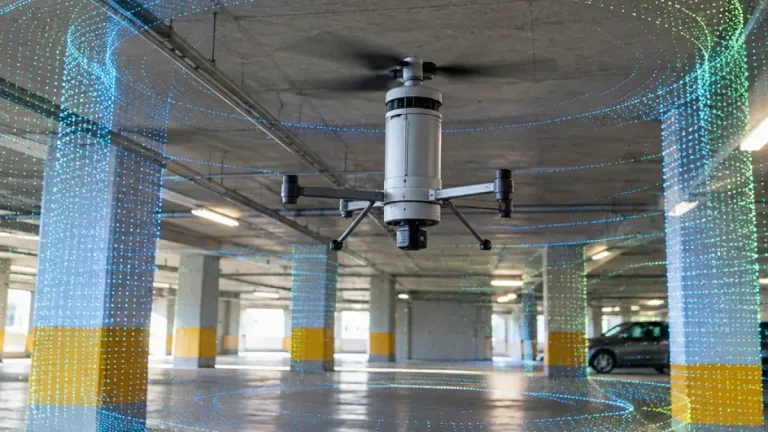
The drone is designed to plan its own flight routes as it explores a bridge. According to the researchers, it uses artificial intelligence to detect hairline cracks that could be missed during a conventional visual inspection. Its navigation system is intended for dark and restricted internal areas where maintaining a clear route can be difficult.
- The aircraft can explore narrow, poorly lit sections inside bridge structures.
- Its software is designed to plan flight routes autonomously.
- AI is used to identify small cracks in concrete surfaces.
- Inspection data is stored locally on an SD card.
The approach addresses several practical problems in bridge inspection. Conventional surveys can require inspectors to spend extended periods on site with a clipboard and camera, while access to difficult sections may increase the time and effort required. Patrick Herbers, MSc, a research assistant involved in the project, said that this method can also be vulnerable to human error.
“Inspectors normally work on site with a clipboard and a camera. This approach is demanding and prone to error,” said Patrick Herbers, MSc.
Bridge condition is driving interest
Many German bridges were built between the 1960s and 1980s, and thousands require annual inspections, according to the report. Traffic volumes and environmental exposure can add to the strain on concrete structures. Heat and frost are among the factors identified as capable of damaging bridge surfaces, making early detection important for maintenance planning and safety assessments.
For an inspection operator, the value of the system would depend on more than its ability to fly autonomously. The drone would need to produce usable records of detected damage and operate reliably in spaces where lighting, access and navigation are constrained. Local storage on an SD card provides a direct way to retain the inspection data collected during a mission, while autonomous route planning is intended to reduce the amount of manual flight management required.
The system has not yet moved beyond the laboratory. It is currently undergoing lab tests, and the team hopes to demonstrate its capabilities inside a real bridge. That distinction is important: the reported crack-detection and navigation capabilities are part of an active research project rather than a completed commercial inspection service.
Müller described the intended outcome in terms of inspection operations rather than aircraft performance:
“Our drone can make inspections safer, faster, and more affordable,” said David Müller, MSc.
A real-bridge demonstration would provide the next test of whether the autonomous aircraft can translate its laboratory functions into repeatable infrastructure surveys. Until then, the project remains an early-stage example of how drones, onboard sensing and AI are being combined to support bridge inspection work.