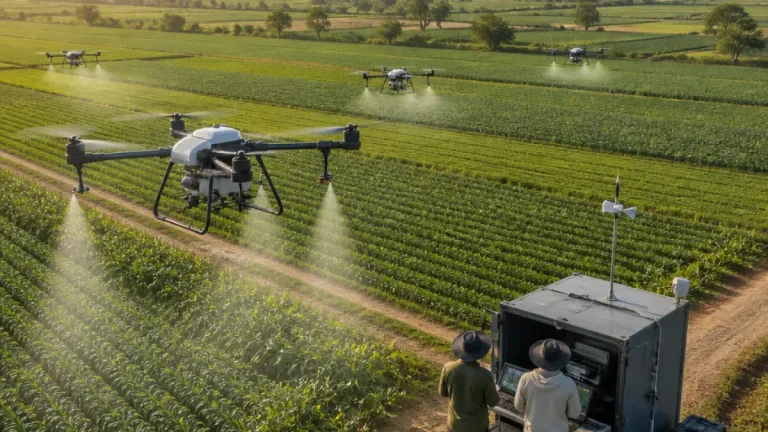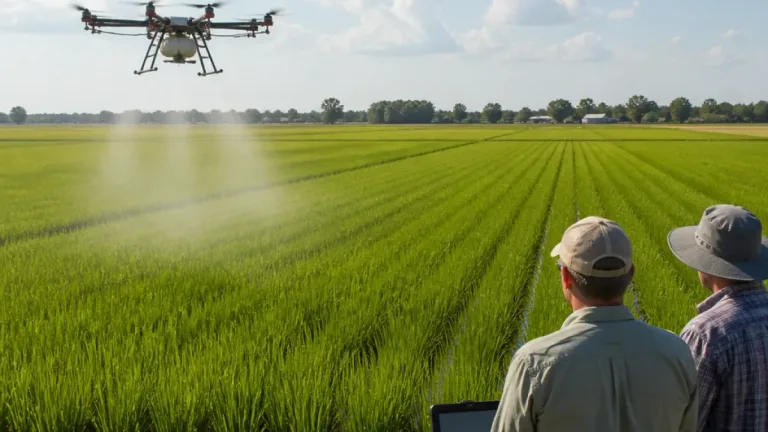
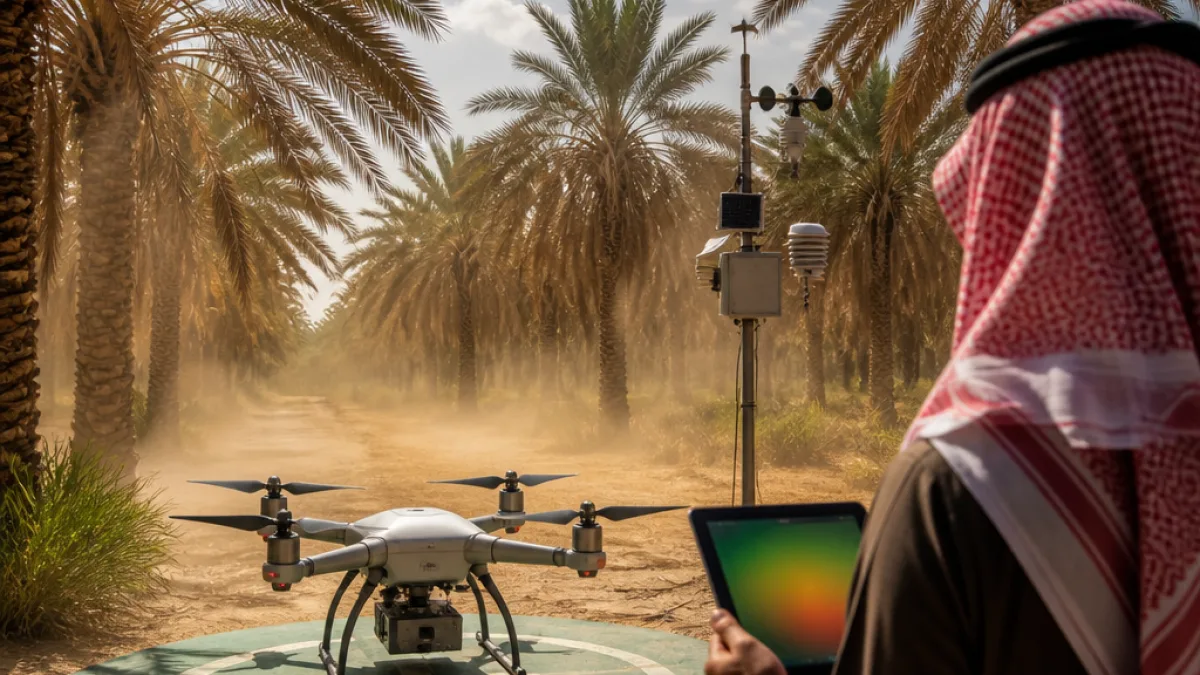
A new study proposes a weather-screening system for agricultural drones operating in Saudi Arabia’s date palm groves, where wind, heat, sandstorms and flash floods can quickly change whether a flight is practical. The framework classifies a planned UAV takeoff as Safe, Caution or Unsafe and is designed to make that assessment in real time.
The research, led by Ahmad B. Alkhodre and colleagues, was published in Discover Internet of Things on October 15, 2026. The authors report that the system reached 99.67 percent accuracy on held-out test data. The work is presented as a proposed scheduling framework, rather than as evidence that the system has been deployed across commercial farms.
A flight-planning problem shaped by weather
Saudi Arabia has roughly 35 million palm trees, according to 2023 statistics cited in the study. UAVs can support disease detection, precision spraying and yield estimation in groves where mature palms make ground-based inspection difficult. They can also reduce the need for manual work involved in monitoring tree health, pest control, irrigation and pollination.
Those uses depend on a narrow and changing operating window. Strong winds, rainstorms, extreme temperatures and high humidity can affect UAV operations, while sandstorms create several hazards at once. The study says blowing sand can reduce visibility, clog propulsion motors, interfere with optical sensors and abrade exposed airframe components. Flash floods in low-lying wadis add another environmental risk to takeoff planning.
Instead of treating weather as a single threshold, the proposed approach combines a rule-based system with several machine-learning models. Its fuzzy-logic component uses a Mamdani fuzzy inference engine. The rules were derived from historical meteorological records and refined by domain experts, allowing the system to respond to rapid changes in environmental conditions.
Combining expert rules with historical data
The second part of the framework uses four tree-based ensemble models: Gradient Boosting, XGBoost, LightGBM and CatBoost. These models were trained on a 15-year archive of Saudi weather data to capture more complex, nonlinear relationships among conditions affecting a potential flight.
The study describes the combination as a specialized integration rather than a new mathematical paradigm. In practical terms, the fuzzy component supplies an interpretable response to changing conditions, while the machine-learning layer identifies patterns in the longer historical record. The output is intended to help determine whether a UAV should take off, wait or remain grounded.
- Classification: Safe, Caution or Unsafe takeoff conditions
- Reported test result: 99.67 percent accuracy on held-out data
- Data basis: 15 years of Saudi weather records
- Target setting: date palm farms in arid regions
The authors frame the system around the operational limits of agricultural UAVs rather than around a particular aircraft model. That distinction matters for farming operations, where a missed spraying, inspection or pollination window can result from conditions that change between scheduling and launch.
The study also highlights a broader challenge for agricultural drone programs: flight planning must account for local environmental conditions as well as the task itself. In Saudi palm groves, the proposed framework is intended to make that decision more systematic. Its reported accuracy comes from the study’s held-out test data; the extracted findings do not establish performance across other crops, climates or operating environments.