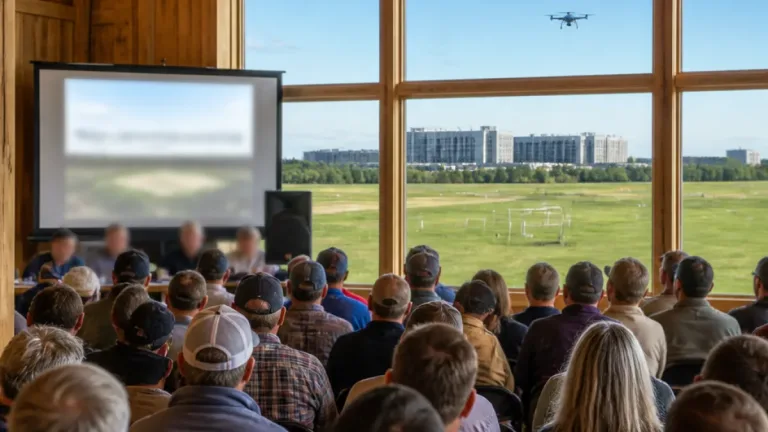
Louisiana farmers and agricultural professionals gathered at the 2026 Southwest Louisiana Drone Conference on Tuesday at the H. Rouse Caffey Rice Research Station South Farm in Crowley. Hosted by the LSU AgCenter, the event focused on how unmanned aircraft can support crop production while giving operators practical information about training, licensing and aviation requirements.
The program covered plant-health monitoring, pest management, insecticide application by spray drone, and the use of aircraft for delivering nutrients, seeding and spraying crop ripeners on sugarcane. Presentations also addressed Federal Aviation Administration regulations and training programs offered through the AgCenter, placing the equipment demonstrations alongside the operational and compliance issues that determine how agricultural drones can be used in the field.
Field demonstrations focused on two types of aircraft
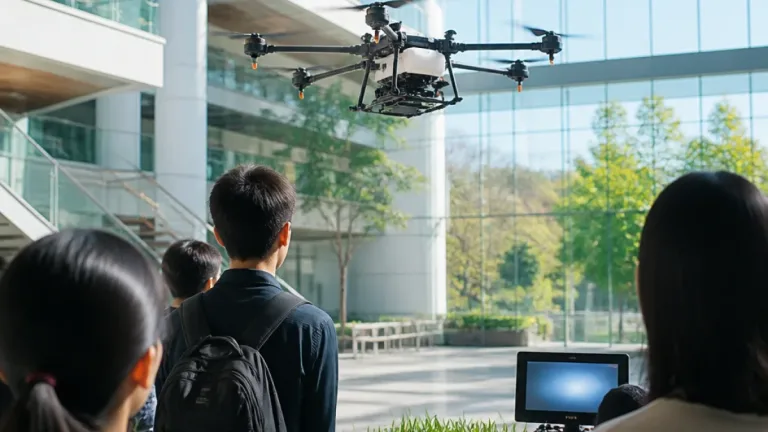
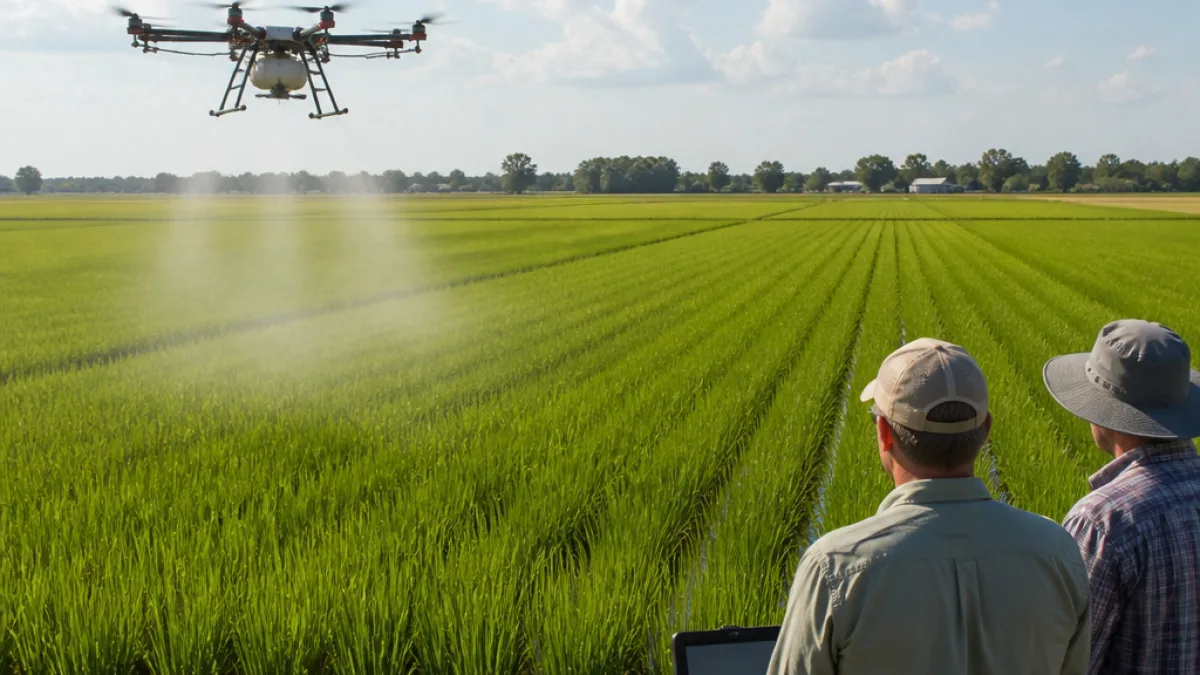
During the outdoor portion of the conference, LSU AgCenter precision-agriculture experts Randy Price and Tri Setiyono operated two different aircraft. Price demonstrated a spray drone intended for applying pesticides and other agricultural products. The aircraft can also support nutrient delivery, seeding and the application of crop ripeners, according to the conference presentation.
Setiyono demonstrated a remote-sensing drone used to collect aerial imagery for crop-health mapping. The aircraft flies systematic passes over a field and captures photographs at regular intervals. Those images can then be processed into maps that help show variation across the growing area, providing a different function from the aircraft used to release agricultural products.
“Drone use is such a rapidly moving industry, our program has already changed from last year just because of the pace that it’s moving. It’s a struggle for some people to keep up to date with the most current rules and regulations and the current practices being used, so our goal is to make sure everybody’s aware of the uses that ag drones can actually provide within their operations.”
Jeremy Hebert, the LSU AgCenter’s Southwest Region coordinator, said the pace of change has made continuing education a central part of the program. The conference therefore treated agricultural drones not simply as equipment purchases, but as systems that require operator knowledge, appropriate training and awareness of current aviation requirements.
Heat was one operating constraint discussed
Price said weather conditions can limit spray-drone operations in southern Louisiana. He reported that the aircraft tended to overheat during the region’s most intense summer conditions, particularly between June and August, and said it would not operate between 2 and 4 p.m. during that period. He also said he was comfortable operating it at a distance of almost half a mile under other conditions.
“Between June and August when it’s super-hot here, this drone would tend to overheat on us. It would never work between 2 and 4 p.m. Other than that, it flew great. I have no problem taking it almost half a mile away and being comfortable with it.”
The remote-sensing demonstration illustrated a separate use case. Setiyono compared the aircraft’s repeated field passes with the pattern used by a crop duster, while emphasizing that its purpose was to gather imagery rather than distribute a treatment. The resulting photographs can be developed into maps for examining crop health across the entire field.
- Spray drone: demonstrated for pesticide distribution, nutrient delivery, seeding and sugarcane crop-ripener applications.
- Remote-sensing drone: used to capture systematic aerial photographs for crop-health mapping.
- Training and compliance: conference sessions covered licensing guidelines, FAA regulations and LSU AgCenter education programs.
- Operating conditions: extreme summer heat was identified as a limitation for the spray aircraft.
The conference reflects the expanding role of drones in Louisiana agriculture, where the practical questions are closely tied to local conditions. The demonstrations showed that different aircraft serve different tasks: one is built around the controlled application of agricultural products, while the other generates data for field analysis. LSU AgCenter researchers also used the event to connect those capabilities with operator training and the rules governing agricultural flights.